The 7th East Surreys at Cambrai

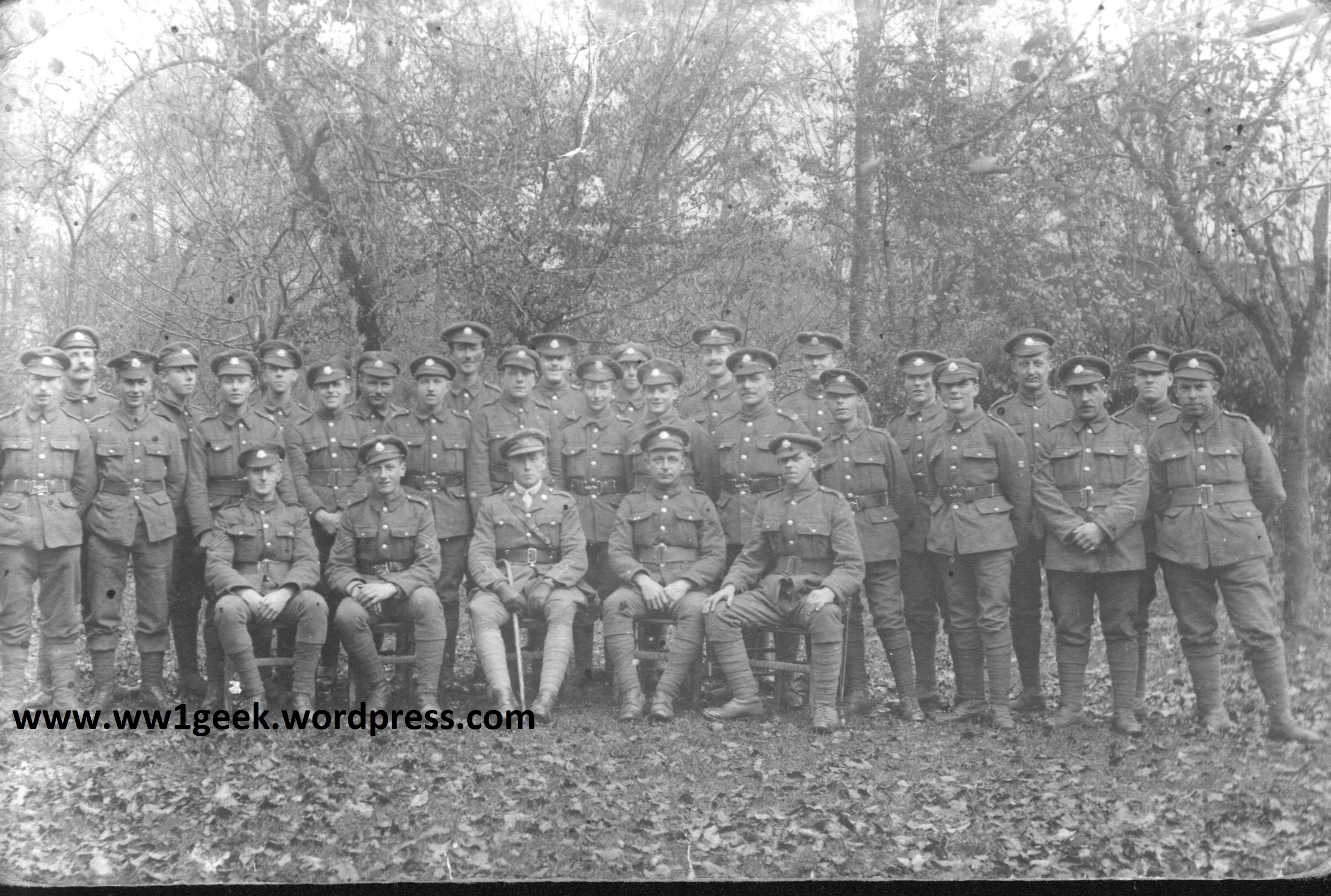
Postcards were produced in abundance during the First World War and can provide a fascinating insight into the men who served. Many were studio pictures of individuals or groups of soldiers, and capture a brief moment of their lives; for many perhaps the only photograph of them that exists. Yet too often on these postcards there is little or no identifying information about the men, and we are left wondering who they were, what they experienced, and ultimately what their fate was.

7th ES, Nov 1917, C Coy, 9 Pl v1

This picture of a group of men from the East Surrey Regiment is typical of many of the surviving postcards, although it was clearly not taken in a studio. The postcard is of men from the East Surrey Regiment, in the front row a Second Lieutenant flanked by three Sergeants and a Corporal, with 25 men behind them. Other than this there is little other identifying information; some good conduct stripes and a drummer’s badge are visible but other than this the only notable thing about the picture is the mixture of belt (P08 & P14) and cap types.

So here we have a photograph of 30 men, with the regiment known and the different ranks visible. This could be the end of the story for this particular postcard, however on the reverse is scrawled “7th Battalion East Surrey Regt; C Company; 9 Platoon. Taken at ‘Bonniers’ France, November 1917.”

The 7th Battalion of the East Surreys was a K1 new army battalion and had gone to France at the beginning of June 1915. Part of the 37th Brigade in the 12th (Eastern) Division, they had participated in actions at Loos and on the Somme.

Bonniers is small village approximately 25 miles west of Arras, and from the battalion war diary we can see that the battalion spent time here from 28th October -15th November 1917.

On 20th November C Company led an attack with tanks near Gonnelieu (ten miles south of Cambrai) as part of the opening day of the Cambrai offensive. The 12th Division were on the right flank of the attack under III Corps, Third Army (Byng). The war diary records:

At 6.20am the Zero barrage opened and tanks could be seen crawling over the ridge in the half light. There was no enemy retaliation at the spot where the Brigade was, as we were only 1800 yards from the German line, luck was with us.

At 6.50am the Battalion moved off by platoon round the road encircling Gonnelieu to the north. Enemy shrapnel was bursting on the road exit from the village. The front line lies almost on the edge of Gonnelieu and in a very short time the leading platoon were in no man’s land.

The hostile barrage was fairly heavy all about this area, especially on the sunken road La Vacquerie Road. This road was therefore avoided. The Battalion gradually shook out into Artillery Formation after leaving the village, and in company with tanks and enemy bullets and shells, moved on towards the Blue Line. Two companies either side of the main Bonavis-Goudeacourt Road. German machine guns and snipers were still firing from Sonnet Farm, although the troops who were taking the first system were well beyond. This was the case throughout the attack and was due to the difficulty of clearing or mopping up in time to keep pace with the advancing troops.

Captain D.F. Roberts was unfortunately killed near Sonnet Farm, by a bullet through the head. The two companies on the left slightly lost direction owing to their following the line of a valley and losing sight of the main road which was our line of advance.

On arrival at the Blue Line some houses on the right which should have been taken, were still holding out and our right two section of tanks were a little late.

cambrai v1

The battalion suffered 16 men killed and 100 wounded in the attack. The war diary records that the C Company officers who took part in the attack were Second Lieutenant E. Jordan and Second Lieutenant H.W. Binstead. Is one of them the officer on the postcard? Binstead survived the war and returned home to Wallington; Jordan was killed on 9th April 1918.

The successes of the opening day of the offensive were short lived and on 30th November the Germans counter-attacked. The battalion was again in action, and the war diary records one officer killed, three wounded, and nine missing (including the battalion’s commanding officer Lieutenant Colonel RH Baldwin, who was wounded and taken prisoner). Five other ranks are listed as killed, 11 wounded, and 260 missing.

Further analysis of the Commonwealth War Graves Commission database for this period shows 19 casualties on 20th November; eight between the 20th and 30th; and 64 for 30th November. Only one of these has a known grave; the remainder are commemorated on Cambrai memorial.

Ultimately one is left wondering how many of the 30 men in the postcard were wounded or killed in the Cambrai offensive, in the weeks after the picture was taken.

Posted in Research, Surrey Regiments, WW1 | Tagged , , | Leave a comment

Carshalton War Memorial – Book out now!

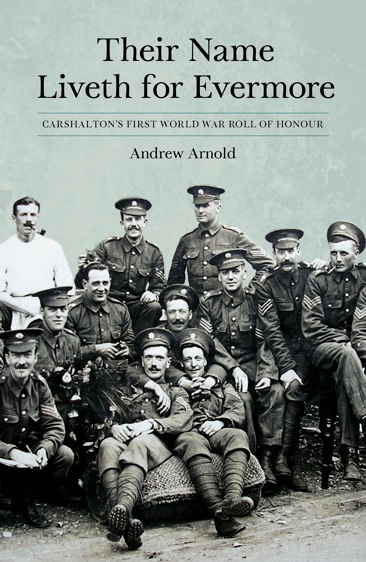
Their Name Liveth for EvermoreI am proud to announce that my book about the men commemorated on Carshalton war memorial, Their Name Liveth for Evermore: Carshalton’s First World War Roll of Honour, is published today by The History Press.

In the words of the blurb on the back: “Carshalton in Surrey was deeply affected by the First World War: over 1,900 local men enlisted to fight. Of those men, 243 lost their lives and are commemorated on the war memorial. As we find ourselves commemorating the centenary of the war, it is more important than ever that these men are not forgotten. Drawing on over six years of research, this book brings together the stories of the lives – and deaths – of these men. Utilising a wide variety of sources and complemented by many previously unseen photographs, their stories are told here, from the fourteen sets of brothers who were killed to the devastating effect of the Somme campaign in which 19 local men lost their lives on the opening day alone.”

It has been an incredible and often moving journey researching the men and their stories over the last few years. If you do read the book, I hope you enjoy it and think it is a fitting tribute to the men.

Now the book is finished I am mulling over the possibility of arranging a local trip to the First World War battlefields to follow in the footsteps of some of the men. It would probably be a day trip to Ypres, or a two-day trip to the Somme, leaving from the Carshalton/Sutton area. Cost would depend on how many people were interested and would probably take place next spring. If you are interested, please let me know by email – no obligation at this stage – carshaltonwarmemorial@yahoo.co.uk

The book is available from Waterstones (Sutton & Croydon), Honeywood museum, and the following online outlets:

The History Press

Amazon

Waterstones

WH Smith

IMG_2712

Posted in Centenary, Projects, War memorials | Tagged , , , , , , | 1 Comment

Sutton war memorial

The war memorials in the London Borough of Sutton have recently benefited from a deep clean in preparation for the centenary. Sutton’s memorial in particular was in dire need of attention, its location overlooking the busy A232 making it a magnet for pollution. I must say, the results are fantastic, and full credit to Sutton Council for organising it and the contractors Stonewest for doing a great job. With the start of the centenary years it seems a timely opportunity to write a little about the memorial and some of the people named on it.

The memorial before and after cleaning

The memorial before and after cleaning

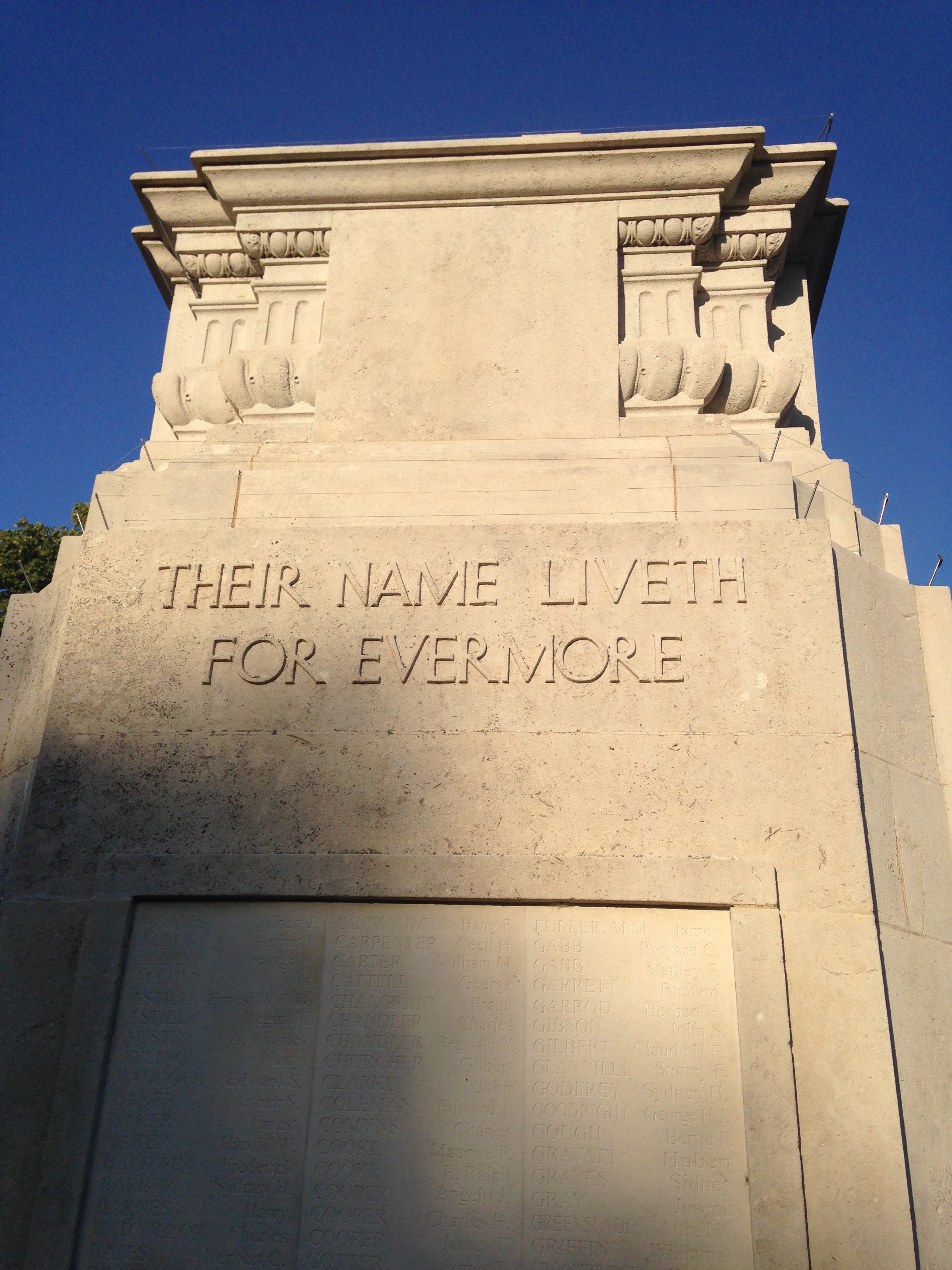
The memorial sits in Manor Park, towards the top of Sutton High Street, and was unveiled in June 1921. It takes the form of a cross of sacrifice atop a large plinth. The four corners of the plinth are adorned with carved angels; three of the sides of the plinth display symbols representing the army, navy, and air force. The inscription on the memorial reads ‘This sign of the great sacrifice is raised in honour of our heroic dead who gave their lives for England in the Great War. Their Name Liveth For Evermore.’ A further plaque records that ‘The people of Sutton erected this monument and dedicated the four acres of ground surrounding it to the use of the public for ever’.

The memorial shortly after it was unveiled in June 1921

The memorial shortly after it was unveiled in June 1921

527 names are inscribed on the memorial’s 12 plaques; over double the number on Carshalton’s memorial. Although I have not gone into anywhere near the depth of research I have with Carshalton’s memorial, I have so far managed to positively identify 489 of those named. The rank of each man is inscribed on the memorial, which in some cases has made it easier to identify the correct individual.

William Barnett

William Barnett

I have covered the story of William Barnett, one of Sutton’s first casualties of the war, in a previous blog post here.

The highest ranking name on the memorial is that of Colonel Robert Burns-Begg. Related to the poet Robert Burns, Burns-Begg was a member of the Scottish Bar and had seen service during the South African war in Kitchener’s Horse, after which he acted as legal adviser to the Transvaal government. In the First World War he was the town commandant of Folkestone. He died whilst on leave in Edinburgh on 9th January 1918 aged 45 and is also commemorated on a plaque in the parish church in Kinross.

No less than 17 of those commemorated were awarded medals for gallantry or were mentioned in despatches. Captain John Charles Mann served as Adjutant with the 2nd Battalion Royal Welch Fusiliers. He had joined up on 7th August 1914 and went to France in November. He was awarded the Military Cross in January 1917 and was posthumously mentioned in despatches in December 1917, having been killed at ‘Black Watch Corner’ near Ypres on 26th September 1917 during Third Ypres. He has no known grave and is commemorated on Tyne Cot memorial. The 2nd Battalion RWF are notable as being the battalion that the writers Siegfried Sassoon and Robert Graves served with, and Mann features in both of their wartime memoirs.

Whilst the majority of Sutton’s casualties were incurred on the western front, a handful died elsewhere.  Captain Wallace Hillbrook died of meningitis in July 1916 whilst serving with the Uganda Medical Service, and is buried in Nairobi South cemetery, a reminder that the war spread far beyond the France and Flanders.

Seven of the names on the memorial do not have a rank inscribed next to them, and I believe they are civilians who were killed whilst carrying out war work. There is at least one woman commemorated on the memorial – Eliza Bailey, who was killed in an explosion at Brocks munitions factory on Gander Green Lane, around late 1916. She was 22. It is possible the other six names were killed in the same incident.

The memorial at Sutton Grammar School

The memorial at Sutton Grammar School

Several other memorials exist in Sutton, including one at the Royal Mail sorting office, a memorial to the old boys of Sutton Grammar School, and naturally several in the local churches. Thirty six of the men are also commemorated on Carshalton war memorial.

I will write more about those named on Sutton war memorial in future blog posts.


Posted in Research, War memorials, WW1 | Tagged , , , , | Leave a comment

Reflections of a Rifleman – Part 5

How much could be written about trench life, revelation in human endurance, and sublime heroism, lit by flashes of humour, but grim tragedy predominating – full to the brim, pressed down, and overflowing. Surely no dwelling ever held such a mixed assembly as gathered beneath the sand bagged-roof of a dugout, adversity indeed bringing strange bedfellows. Here all barriers of caste and calling were broken down, and common danger had brought common fellowship. Your solicitor’s clerk rubbed shoulders with a brewer’s drayman, and the commercial traveller found an excellent comrade in a coster. “Cook’s son, duke’s son, son of a belted earl” had once again met in a glorious comradeship.

There was J—-, whose nature was steeped in poetry, who brought refinement and romance into an atmosphere too often sordid and whose ideals were undimmed by the grim horrors of war. There was little B—-, inclined to be a pessimist and often given furiously to grumble, yet in his merry moments the best of companions. There was Patrick, the rebel, lacking suavity but staunch and true, who denounced the Saxon to the Saxon’s unending delight. Then Chris, philosopher and man of action, whose inventive genius added to the comfort and convenience of dugout or hut.  Also Peter, the man of moods, difficult to understand, admitted sensualist, unorthodox in everything yet found his soul’s expression in song. The hearts he moved to tears or turned to laughter with his glorious singing will ever regard his memory with affection. Then T—-, who carried Gibbon in his haversack, and was learned in literary lore. Resting one night by the roadside, on a journey up the line that to him was momentous, for its brought him a “Blighty”, he told me with impassioned eloquence how he hated the mechanism of war. Yet love of liberty had called him to the colours. The God of Battles protect them all!

Winter severity proved to us how terrible an enemy climatic conditions can be. Often as I stood vigil on the firestep for my hour of sentry, knocking my feet together to excite warmth, or paced to and fro on the duckboards, have I recalled that terribly realistic picture drawn by Tolstoy of the sufferings of the men in the trenches of Sebastopol. I am not for a moment, of course, comparing our modern conditions to the terrible rigours of the Crimea, but when it is remembered that the Russian soldiers were seasoned troops, while ours are drawn from civil life, whose calling in most cases ill prepares them for hardships, we must marvel at the endurance of the khaki-clad legions. No man’s land looked strangely romantic and full of mystery when covered in snow. On these occasions those going out on patrol wore white smocks with cowls, the more easily to escape observation, and it was weird to see them depart like a file of Carthusian monks.

At length winter drew to a close, and one experienced that indefinable feeling of spring in the air that makes the blood course through the veins, and makes one feel glad to be alive. On one sector poppies and daisies grew on parapets and parados, and between our front and support trenches was an orchard with trees of apple blossom. Often during a “strafe”, with death-dealing shells dropping perilously near, I have gazed fixedly at these evidences of life and beauty and realised as never before how dear life was, and prayed the God of Infinite Mercy to spare me to enjoy it another decade. At all moments though the dainty colouring of flowers and the refreshing green leaves were a joy and an inspiration. It reminded one of Omar’s lines:-

I sometimes think that never grows so red
The rose as where some buried Caesar bled.

Spring brought other things besides flowers – “offensives”, “increased activities”, and suchlike! Raids were the order of the day, freely indulged in by both sides along the wide spread battle front. Eventually our battalion had one all to itself. It was elaborately thought out, and for some weeks rehearsed daily. Eastertide was the time chosen, and accordingly on Good Friday night we entered the line at a given sector. The following day was spent in resting and making final preparations. The Lewis gunners and the bombers knew their place in the scheme of things, and every man knew his job. Bombs, ammunition, spikes, sacks and scaling ladders were issued out, and distinguishing badges pinned to the back of every man. Zero was at 8 o’clock in the evening, and as the day advanced one felt a strange excitement in the blood and a nervous tension in the atmosphere which manifested itself in the faces of one’s comrades. About a quarter to eight men were brought up from support and reserve trenches, and soon the front line was full, the men leaning motionless against the parapet to avoid being observed by aircraft, which are generally active in the between lights of a day’s close.

It was a unique a moment for a study of human expression. One saw men mad with fear, or impervious to it. The dread possibilities of the moment had touched chords that responded to the whole gamut of human emotions. I shall never forget the faces of those who stood beside me, with a grim look of determination, clutching their rifles. Some were young, others long past the fighting age, all bound by the strongest of human ties to some home, and some loved one. Oh, the pity, and yet the grandeur of it all!  I noticed C—-, a refined intellectual young man, frail in body but strong in purpose. In features he was wonderfully like the famous “Portrait of Cardinal Newman at the age of 19”. He was looking at a glorious sunset behind our lines, and on my questioning him as to his thoughts he quietly answered, “I was wondering if I should witness tomorrow’s.”

While active, man has renewed nerve and energy, but inactivity paralyses, and the tedium was becoming insupportable. With dramatic suddenness our bombardment began, heralded by signals of golden rain fountains, and pillars of white smoke on the flanks of the battalion front. The earth trembled, and the skies seemed to belch forth fire. The noise was terrific, and the air was full of the odour of cordite and noxious gases. The trench rocked with the concussion of the exploding shells, and splinters of shrapnel were hurtling through space. The traverse of machine gun bullets swept the parapets that in a moment would be mounted by the waiting men below. At last the barrage lifted from the German front line, and the order came galvanising the lines of hidden men into life. “Up and over!” And they climbed over, dashing with a sublime heroism into the veritable hell I have attempted so feebly to describe.

If any faltered it was but for a moment. The example of their fellows restored their courage, and with a wild cry they followed into the grim uncertainties of no man’s land. They followed on in the wake of our barrage, penetrating to the third and fourth German line. Having gained their objective, they remained nearly an hour capturing prisoners and gaining valuable information, after which “all that was left of them” returned to our lines. The leadership and courage of our officers that night were magnificent. Within two hours the raid was over, and silence reigned in no man’s land, broken only by the cries of the wounded.

I remember as I stood in our trench after the raid wondering if the people at home could ever dimly realise all we were enduring. London at that moment was flocking into the theatres and cafes, more interested probably in the latest society scandal than the war. It is horrible to reflect, yet very human, I suppose, seeing the battles are served up twice daily. Other interests have almost obscured the war. People think of casualties as if they were runs at cricket or figures in a game book. We know them as synonymous for poor shattered humanity, broken for life, or in its death agonies calling upon its Maker. In the early hours of Easter day we plodded from the line, along the tortuous, shell ridden roads, back to the camp. Many of us felt the influence of reaction, all of us were weary.

Since that memorable Easter I have gone from sensation to sensation and taken a humble part in the series of advances that began with the great battle of Messines and continues to the present moment, engagements besides which our raid pales into insignificance. At some future date I may records these experiences, but for the present I conclude my narrative. I have written sufficient to give those at home at least a slight glimpse into the life of Tommy on “Active Service”, and the thoughts that occupy his mind. I have taken no fiendish pleasure in sickening the reader with an orgy of blood lust, but I have given sufficient detail to make him realise the ferocity of war, and how unutterably loathsome it is. I have impressed upon him also the debt he owes to the khaki-clad legion who hold the front line, keeping vigil through long days and in the lonely watches of the night, standing between him and the horror and desolation that have laid waste the plains of France and Belgium. Upon the sacrifices of these heroes will be built the victory that ultimately will assuredly be ours. And victory once over, let us work for the permanent peace of the world, enriching it with the rewards of industry and enterprise, that when our children’s children visits the plains now ravaged and desolate they may be able to say with R.L.S.:

We travelled in the print of olden wars,
Yet all the land was green,
And love we found and peace,
Where fire and war had been.
They pass and smile, the children of the sword;
No more the sword they wield.
And, oh, how deep the corn
Along the battlefield!

THE END

Posted in WW1 | Tagged , , | Leave a comment

Reflections of a Rifleman – Part 4

“A Chiel’s amang you takin’ notes and, faith, he’ll prent it.” – Burns

Our trek ended some few miles beyond the Belgian frontier at a camp of crude, draughty huts.  The whole district for miles around was full of such camps, a kind of headquarters from which we went at regular intervals up the line.  The huts were built quadrangle fashion round a field that did duty as a parade ground.  Here while out on rest routine was pretty much as I have earlier described, drills, inspections and route marches during the morning, with the evenings left to ourselves. Passes to the neighbouring villages or the nearest town were easy to obtain, while scattered along adjoining roads were numerous estaminets and coffee shops. With a keen eye to business, the Belgian peasant has erected in close proximity to every camp his rude wooden shanty with dainties for Tommy. It is astonishing how the peasant has clung to his native hearth, even when it lay levelled in the dust, and beside it often he has raised a humble structure of wood or tin and torso to assert his inalienable right to the soil. It matters not if the district be still within shelling distance, he is willing to take the risk. During the winter evenings we lit braziers in the centre of the hut, and sat around reading, writing or chatting.  But without, on the parade square, the pipers play their evening selection of Irish areas, while the officers dine. About 9 o’clock we filed up for our rum issue to the Sergeants’ mess, after which we returned to the hut, put down our waterproof sheet, coiled ourselves up in a blanket, and often before “Lights out” were sound asleep. During our term at the camp days were set apart for sports, general inspections and special parades, while Sunday was free after church parade. Our period at the camp was rarely longer than eight days, after which we went into the line for a term of eight days in the reserve, and eight in the frontline trenches.

It must be confessed that our journeys to the line were weary pilgrimages, a long trudge bearing our heavy pack and equipment, the terrible roads were pockmarked with shell holes, full of water and mud. As we approached the trenches we walked in single file, with intervals of fifty yards between the platoons, in order to minimize the danger from shelling. The very lights appeared to nearer, the ground yet more ravaged and presently we descended into of communication trench. As with nearly all communication trenches it was tortuous and seemingly endless. I was at once impressed by the total difference between the conditions here and those prevailing in the war area we left. On the Somme there had been recent fighting and great advances, but on the Belgian sector there had been no offensive for nearly two years. Both sides had had time to consolidate, and entrench themselves, much of the land had been mined and tunnelled, and advantage had been taken of every point of observation. The trenches were well made, with dugouts at intervals, and filled with duck boards. Here and there support trenches branched off, having such romantic names as Lovers’ Lane, Hedge Row and Convent Lane; some, with even less regard for the truth, proclaiming themselves Regent Street, Fleet Street, and such like. Now and again a stronger and better built dugout betrayed its importance as GHQ. Nearly always at such a centre or at the junction of two or more trenches, a sentry was posted whose chief duty was gas guard, to sound the gong at the first signs of gas. The telephone wires crossed and recrossed the trenches, constituting at times a veritable nuisance pinging against one’s helmets or clinging to the swivels of your rifle.

You trudge along single file, wearied and morose, turning the corners of innumerable traverses, tripping here and there over wires or a broken duck board. Those journeys to and from the line on dark winter nights constitute the most dismal of memories.  Tommy will always tell you they got him down more than actual residence in the line.  The man in front of you passes down the warning messages, “Hole left”, “Mind the rails”, or “Wire right”, but the odds are that you will step into the very trap you are most anxious to avoid, with disastrous results. While you are struggling to extricate yourself, knee deep in water or slime, the raucous voice of an NCO bids you “Get along there”, and the air behind you is blue with language more forcible than polite, for Fritz may shell at any moment. Most trying experience of all after a long trudge is to confront in a narrow trench another company of men who have to pass you. You press close to the side of the trench, while the men wriggle through, their equipment getting entangled in yours, to your mutual annoyance.  They, however, are inclined to be tolerant, for their steps are bent towards rest billets, while our goal being the front line, our temper is at breaking point.

At some length we reach the frontline trench, with its parapet and a parados piled high with sandbags. At places the trench is not in the good condition of those in support and reserve and one wades through water ankle deep. Fritz has been unkind enough to draw up an occasional shell there, and we have not had time, perhaps, to repair it. On arriving we immediately “take over” from the battalion holding the line, post sentries, and settle down in the nearest dugout. After the more active warfare of the Somme, this section was surprisingly quiet, occasioned to some extent, of course, by the advent of winter.  Sentry-go lasted for two hours and was an ordeal that strained the nerves to an extent that cannot be imagined. In our sector the Boche was but 25 yards away, and one had to be all alert. When one has gazed fixedly into the darkness of no man’s land for even an hour, the eyes become dim and wearied and apt to be deceived as to the nature of the object that lies before them. Just the reverse of the Scriptural observation, one can see trees like men walking. At moments like these it is advisable to get the officer on duty to send up a Verey light, when for a brief moment darker patch of no man’s land is lit up, and you settle that little doubt of yours.

What a relief to come down off sentry and coil oneself up in the dugout and sleep. I have known nights to pass without any shellfire, but generally there were minor strafes at intervals. Fritz’s shells were chiefly directed at the supports and reserves, because of the close proximity of our front line to his own. For the front line he reserved rifle grenades, trench mortars, and suchlike. During our stay on this sector we lost almost as many men from spasmodic shelling and sniping as if we had taken part in an advance. At one time the regiment facing us must have been a regiment of sharpshooters, for their shooting was remarkably good. They frequently riddled our periscopes, and at night they swept our parapets, and also accounted for many of our men. Their aim seemed deadly, even uncanny. Perhaps the most anxious moment of the day, weird almost in the effect they had on the nervous system, were the “stand-to” in the grey hours of the morning, watching the sun rise over the German trenches, and the “stand-to” at eventide, when it sank in a blaze of colour behind our own. Dawn and dusk were the times to be feared, for usually those hours are chosen for an attack. Every man turned out of his dugout, donned his equipment, and fixed bayonets. At the “stand-to” at dawn a sergeant came round with a rum issue, badly needed those bitterly cold mornings, as a tonic to the nerves. Before my army career I had never touched the spirit and, if anything, was prejudiced against its issue to the troops, but a week in the trenches gave me a broader outlook.

Occasionally we light a brazier, and a discreet glance through the periscope shows that Fritz a quarter of a hundred yards away is similarly engaged, for a blue wreath of smoke arises from the line of trenches. At rare intervals our friends the enemy could be seen hastily passing by a gap in the trenches or flitting from tree to tree on the horizon. Our dugouts were rarely up to the standard set by Fritz, for we knew that our stay was temporary, while he hoped for a permanent residence. Making due allowance for this most excellent of reasons, my attitude towards our dugouts is anything but friendly. Memories of irksome crawls into darksome holes over damp ground, the nostrils assailed meanwhile with pungent odours, have embittered me.  In such dwellings we lived, moved and had our being for days and nights, our “home from home”.  Oh, the pleasure of crawling out, assuming once more the erect posture natural to the genus homo, for often these habitations were barely three feet high!  In the trenches too, the little man can strut along at natural stature, while the tall man walks with bowed head and bent back to avoid the little winged messengers of death that skim the top of the parapet. Even in the rest billets out of the line, height is a disadvantage, for when weight-lifting for fatigues are about the NCO generally regards it as synonymous with strength.

To those who outlive this conflict, how strange it will be to recall the days and nights without number spent in the weird, wonderful atmosphere of the trenches. Days of wearisome boredom, for even shelling “thrills” can become monotonous! Nights of anxious alertness, amid uncanny stillness, developing at times into excited nerveiness as the silence is broken by an outbreak of gunfire and the sky lit by an ever increasing succession of flashes. Meal times were the long looked for breaks in the day’s monotony, when we filed up with our mess tins for our tea and bacon, or the never failing stew. Curiously enough, or as we thought designedly, Fritz always began a half hour’s “strafe” at meal times, much to our annoyance. Once this was over we could rely almost for a certainty on a few hours peace and quietness, during which we “cleaned up”, performing our ablutions in a shell hole, wrote letters, read a book, or curled ourselves up in the dugout and had a sleep. This may read strange to those at home, after being informed that but 25 yards separated us from the Boche, but it must be remembered that winter held the land in its thrall and rendered advances, or anything of an active nature, impossible. One chiefly had to guard against bombing raids.

As I have pointed out the almost timed regularity of Fritz’s shelling in this particular sector was most convenient to us. We were not nearly so considerate to our friends the enemy, for our “strafes” began with dramatic suddenness, at all manner of odd moments. Our artillery was marvellous for power and accuracy. While on sentry one afternoon I watched through the periscope the work of our shells on the German front line. Beginning on the left they travelled with deadly aim the whole trench, leaving it a line of shell holes and broken earthworks, almost useless for occupation.  For every shell Fritz sent over he received a dozen in return, a decided improvement on our unhappy position twelve months previous.

Fifth and final part to follow soon…

Posted in WW1 | Tagged , , , , | Leave a comment

Reflections of a Rifleman – Part 3

Our Division being at length relieved, we retraced our steps across the immortal battlefields that compose the desolate wastes of the Somme, and after a brief halt at Albert we joined the battalion at the little French village of Francevilliers. Here and there were few traces of actual warfare, save for the ever present khaki and the endless procession of gun lorries and ammunition wagons that passed our billets. We were quartered in barns on each side of the main street, and during our period there, as always when out on rest, had our pleasant moments of relaxation. The mornings we always spent on an adjoining field, practising squad drill, musketry, and other routines of a peacetime soldier. This was never an agreeable programme and almost seemed an indignity to men who had experienced the “real thing” and objected to being treated as raw recruits. However it is easy to see the wisdom of it all. For apart from its usefulness in refreshing those who had become lax in drills and discipline it had a healthy influence on the mind, helping it to recover from the horrors it had witnessed during its term in the line. The afternoons were chiefly devoted to sports or minor parades, while after tea the time was entirely our own.

It was a straggling village, far from beautiful, but quaint and restful, and possessing that indefinable charm always associated with the French atmosphere. The majority of the shops are devoted to articles calculated to appeal to Tommy, chiefly chocolates, while there is a good muster of estaminets where he can look on the wine while it is red, also there are quiet farmhouses and homely cottages where one can drink delightful French coffee and exchange greetings in imperfect French or English with a “vision” of Parisian colour and vivacity. From the centre of the village, arose the stunted tower of a sweet little church, a giant crucifix looked down upon our parade ground, while “M. Le Cure down the street goes with his kind old face.”

Shortly afterwards we said good-bye to France and the battlefields of the Somme and began the trek to the new sphere of our operations – Belgium. The battalion marched to Albert, where we bivouaced in Station Square till midnight awaiting train. The October night was cold, so we lit fires, made tea and gathering round the warm bright flare we let ourselves “go” forgetting the past and evading the future in an intoxicating burst of song. Song is Tommy’s great medium for manifesting his soul and its victory over circumstances and environment. Through it he proclaims his triumph over physical fatigue and mental depression. It helps him to retain his self respect while performing the most menial of duties, keeps time with the gay rhythm of his feet on a route march, and proclaims his soul’s defiance of death and danger as he goes “over the top” into the jaws of hell. The embers of our fires were nearly dead when we entrained in one of those great troop trains that have swept so many thousands across the plains of France. As dawn broke we were passing through fields of refreshing green, amid some of the most beautiful of French scenery, catching here and there autumn tints from woods and forests, or the reflection of the morning sun in sparkling streamlets or still waters. No longer did the eye gaze upon a wilderness of craters and woods of blasted stems and stripped branches. Here nature was clothed in her proper raiment, filling the eye with her beauty and colour and the soul with her peace and restfulness. Her splendour chased away all memories of past horrors, and even the most worldly amongst us echoed words that we saw engraven on the hill slopes of Wimereux – “Gloire a Jesus Christ”.

We lived in the train for two days and nights, passing through towns whose names loom large in European history. At length we alighted at ——, from which we began the trek by road to Belgium, lasting several days. It is an interesting sight to see a battalion on the move. The commanding officer heads the cortege on horseback, accompanied by his aide-de-camp, and followed by their grooms. Then comes the band, in our case the Irish pipers, followed by a company of men headed by their O.C. The remaining three companies follow in the same order, but changing positions at the halts for rest in order to share the advantage of the band. Last, but not least, comes the domestic side of the battalion’s existence, the Quartermaster’s stores, the tailor’s shop, the bootmakers, the armourer, and most important of all, the procession of travelling kitchens, for it is a truism that an army marches on its stomach. As they pass a pungent odour assails the nostrils, for a savoury stew is being prepared for the midday halt. No matter how long and tiring the journey, there is something exhilarating in the swinging motion of a march, and a pleasure in the changing panorama on either side. Tommy holds his head very high too and experiences a strange thrill as he marches through the quaint cobbled streets of the beautiful old world town, bringing to their doors all the inhabitants, who gaze with a look of curious interest that ripens here and there into enthusiastic admiration. The spectators may not be so demonstrative now as formerly (everything becomes commonplace in time and thousands of the khaki-clad have passed the same way), but the admiration is still there.

At night the battalion is billeted in barns, in villages “booked” previously by a billeting party. Crude as our dwelling might be it has often been the background of a memory that will stick. I have stood at the barn door and gazed down on a smiling valley whose slopes were richly coloured with fields of maize or ripened corn, or again at a great ploughed landscape with the figures of peasants at work silhouetted against the setting sun, as depicted by Millet or described by Baxin. Memories also of vaulty interiors of fine old farm houses, with the polished French stoves jutting out from beneath the mantelshelf, supplying heat, and on which ever reposed the coffee pot, filling the atmosphere with its refreshing aroma. The walls, too, hung with the quaint old china plates, and at intervals portraits of the old race, while most prominent of all was the crucifix that looked down on the hardy farmer, his wife and their children, as they took their meals, and, most cherished memory of all, the little French mademoiselle of eight summers whose acquaintance I made at a well and who insisted on showing me the orchard, plying me meanwhile with questions in quite excellent English. Within a few days, during which our intercourse had ripened into friendship, we parted, and the picture of her waving farewell with all the sincerity of childhood as the battalion marched off will ever have an honoured place in my gallery of memories.

She went her unremembering way
She went and left in men
The pang of all the partings gone
And partings yet to be.

Towards the close of our trek the nature of the country changed from the slightly undulating to the less interesting stretches of flat land, marked here and there with innumerable windmills, and presently we crossed the frontier and were in Belgium. The roads differed little from the French, save in the Flemish names over the estaminets and the larger number of wayside shrines. The latter vary in kind from the more elaborate brick chapel with its altar and tastefully arranged flowers and candles to the humble little statue within a wall niche, or even fixed to the bough of some noble tree. They are all very impressive, most of all perhaps the great crucifixes that hang from the outside of every parish church, or stand towering at the crossroads, asking the age old question “Quo Vadis?” – “Is it nothing? to all ye who run by?” I am sure it has often been answered by the rude oath left unsaid and evil thought checked at the sight of these religious emblems. Flanders is the land of the crucifix, and even in the estaminets it is a prominent feature. Religion seems to enter into the every-day life of the people.

I promised to record my “reflections” upon Tommy’s attitude towards religion, and how it has been affected by the war, and this seems to be a good point at which to fulfil it. A casual observer, perhaps, would find little difference between the peacetime soldier and the war-time Tommy. Like Mr. Weller’s knowledge of London, Tommy’s speech has ever been “extensive and peculiar,” and if anything it is more descriptive in these days of long marches and working parties. As to conduct, well, foreign service brings its quota of temptations. Beneath all, however, there lies in the soldier’s temperament a bedrock of good nature and sound discipline. Tommy, though, is curiously sensitive of showing his better nature. It is more his mental attitude than anything else that has been affected. To a far greater extent than the people at home, he has been set “furiously to think” by the great happenings of this world war. Brought face to face with the great problems of life and death, with one foot often on the border line of a new existence, the supernatural has loomed larger upon his horizon than ever before. No atheist has ever gone over the top, but to my knowledge our boys have mounted the parapet with a prayer on their lips, and a rosary suspended from their necks. Early in the war, the Press was full of the vision that was alleged to have appeared in angelic form to our Tommies on the battlefield of Mons. It is strange enough to be believed, too beautiful to be untrue. That the firmer believers in the vision were the Tommies themselves is proof enough of how the war, in the Army at least, has crushed the materialism and enthroned the supernatural in men’s minds.

To be continued…

Posted in WW1 | Tagged , , , , , , , , | Leave a comment

Reflections of a Rifleman – Part 2

Albert in peace times, I should think, was a fairly prosperous town. Now it is merely a heap of ruins, the railway station being about the best preserved structure. The most remarkable feature is the modern red cathedral, nearly battered to pieces. Here and there, however, there is a portion strangely preserved, notably a very fine mosaic of St. Joseph over one of the doors, and then most wonderful of all the great gilt Madonna and Child that once surmounted the tower, now hanging horizontally over the road in an attitude of appeal to all that pass beneath to hearken to the counsel given at the advent of the Christ Child, “Peace on earth and goodwill towards men.” Everywhere we travelled on active service we met with the same experience, the wonderful preservation of crucifixes and other religious emblems, and it has made a profound impression on Tommy.

After breakfast, partaken of in a ruined cellar, we marched out of Albert along the main road on to Bricoust Wood. Nothing that I have since experienced has effaced the impression made on me by all I observed on that march. The road had been kept in good condition by a Navvy’s Battalion, but on either side was ruin and devastation. On our way we passed companies of many regiments returning from the line for a brief rest. The men looked weary, and is some cases dragged rather than marched along, their expression “puzzled looking” as H.G. Wells would term it, and appropriately too, for what greater riddle than the problem of life and death as they had encountered it? They were smothered in mud and dust, yet not too weary to scan us curiously, as if to ascertain what manner of men were to their place in the hell they had left behind. Now one came across a huge ammunition dump, where hundreds of shells were being unloaded from railway trucks or into motor lorries, and then at intervals one walked across level crossings of the railways that seem to run everywhere behind the British front, following up every advance we make.

A little further along was a cemetery that, in common with all around it, had suffered the ravages of war, and whose desecrated monuments cried to heaven for vengeance. Still more pathetic are the clusters of white crosses that mark the last resting places of those who in the early stages of the war gave up their lives with a quiet heroism that will be immortal. On we marched through arcades of waiting lorries, a perpetual procession of motor vans plying at a swift pace past us, a motor carrying staff officers relieving the monotony at times, and the ever present Red Cross ambulance speeding on its humanitarian errand. One vehicle we encountered at which we gazed with wistful eyes, the sight of it opening the floodgates of memory, the old Blighty motor bus. At intervals, too, traction engines drawing huge guns plod along slowly but surely. On every side, one was overawed by the organisation, marvelling at the intelligence that thought it out, and staggered by the finances necessary to carry it into practice. All is bustling life, every man busy at his appointed task.

It was a long march, and we had to rest frequently. The long marches are often the most severe test of endurance to Tommy staggering beneath the weight of some 96 pounds, often more. As we proceeded the appearance of the country became more ravaged and ruined, save perhaps for an untouched oasis here and there. One of these, Bricoust Wood, was our destination, which we at length reached. Our draft was immediately paraded by the Regimental Sergeant Major, who with cruel disregard of our feelings split us up into different companies, separating in almost every instance bosom friends. As with everything else in the Army, we had to grin and bear it. Here more than anywhere else is the philosophical temperament a God-send. After being issues with steel helmets, ugly in appearance and an additional seven pounds in weight, we were dismissed. We spent the rest of the day in fashioning for ourselves a rude shelter made of twigs and tree stumps, overlaid with leaves, sufficient to hold four of us. However, we were but amateurs, and during the night we were awakened by heavy rain, which had thoroughly drenched us, and reduced our shelter to a skeleton. Our spirits were slightly damped also, but the morning breakfast and bright sunshine restored us to ourselves.

Our rations at this period were four in a loaf, a portion of cheese each, and a tin of jam between six. The jam, nearly always apricot, gave rise to the famous Bairnsfather cartoon, “When the —— is it going to be strawberry?” Then for breakfast there was the additional course of a rasher of bacon, and for dinner the eternal stew, not too bad, considering! The morning the battalion left Bricoust, and, headed by the pipers, we marched through miles of devastated country to Mametz Wood. How much the British Tommy owes to his band, that accompanies him within a few miles of the battle front, helping him to forget the fatigues of his journey, nerving him to action, and when it is over bringing balm to his distracted and weary spirit! Not for the first time had the battle grounds of Europe heard the lilt of Irish pipers leading to victory or death the men of a fighting race, for

On far foreign fields from Dunkirk to Belgrade, Lie the soldiers and chiefs of the Irish Brigade.

Barely had we settled in Mametz Wood when I was appointed to my first “working party”, chosen as one of five to clear the historic battle field of High Wood. We started off at once, tramping through indescribable filth for miles, till we reached the great expanse that had witnessed one of the most sanguinary battles of the world war.

Picture a desolate waste that extends as far as the eye can reach, pock-marked with countless shell holes, interrupted at intervals with trenches, or rather breastworks, that wind serpent like along till lost to sight, littered with every form of salvage and strewn with human bodies. But reader! CAN you picture it? It has to be seen to be realised.

We settled in a rude trench, digging funk holes for ourselves. The funk holes vary in kind, from the cavity into which Tommy thrusts his head ostrich-like to the more roomy space in which he can lie at length, his waterproof sheet forming an excellent covering for the entrance. For most of the night it was drizzling with rain, and we were soon standing in churned up mud. Going very carefully to work, for smoke might be observed by the Boche with unpleasant results, we lit a small fire in a scooped out hole and made ourselves a meal. There was something familiar to me about the appearance of a neighbour a few funk holes away, and moved half by generosity and half by curiosity I invited him to a drink of tea. I soon discovered that I had been a regular client of his at his little book shop in Charing Cross Road, in the spacious days of peace. He remarked how life as he was at present living it had supplemented the written word in broadening is outlook and extending his sympathies. His wife – admirable woman – is carrying on in his absence. I have not seen him since, but I cherish the hope of meeting him again in the dim little shop with all our friends that stand mute now upon the shelves awaiting the return of their master.

All that night the cannonade was terrific, and a comrade and I sat huddled together uncomfortably, for there was barely room for one, unable to sleep because of our fears and the terrible din. Yet the Boche was some distance away, and was not sending many shells over, the noise being chiefly from our own guns. Recollect, though, that we were new to it all. My companion trembled, but it affected me differently, a wretched faint feeling possessing me. The following day, an October Sunday morning, we left the trench and walked out across the battlefield towards the spot where we were to commence our task of burying the dead. The chaplain and officers had not arrived yet, and there was ample food for reflection in all that lay around. It was a scene of the most appalling horror and human dereliction. Even the torn and mangled ground seemed to suggest that mother earth had sickened at the sight. The lifeless bodies of friend and foe lay side by side in the kinship of death, their feuds ceased, never to be resumed. Some had lain there a fortnight nearly, and their blackened remains lent an additional horror to the circumstances of death, others had still upon their faces the colour of life. One was filled with love and pity for them all, British and Boche alike, and Lowell’s lines came to our mind: – “Salute the sacred dead, beautiful evermore and with rays of morn on their white shields of expectation”.

Few more touching sights were there than that of two young German boys lying face downwards in a shell hole, their arms round each other’s necks as if in brotherly embrace. Often beside the poor stricken bodies lie photos of their dear ones, rudely shaken from their pockets. Thank God that the womenfolk cannot see what the sad, but decent phrase, “killed in action”, often means. Yet I think that intuitively they know more than we suppose. Their eyes see further than the brave flash of steel, their ears hear other shouts than the noise of victory. The officers having arrived, we set to work digging a huge pit, and in other respects were proceeding with our task when we were shelled by the Germans, who had observed us. We had the narrowest of escapes, and experienced the ghastly feeling that sickens the heart when a shell bursts close. We made a dash for a distant trench held, I think, by a North Country regiment, which we reached in safety. When quieter we returned to our task, only to be greeted with further shells which compelled us to return to our trenches. Frankly, I was not sorry to escape from a duty which, however noble and Christian, was always particularly painful to me, intimacy with death even in its more natural and less horrible form filling me with a curious dread. From a sense of duty and by sheer force of will I have long since conquered this weakness.

Under cover of darkness we moved that evening to the second line trenches. At a junction in the trenches we lost our guide and, realising the danger of proceeding with our limited knowledge of the geography of those parts, we remained at the point we had reached, securing the nearest funk holes. In our long journey through the tortuous zig-zag of trenches – or more correctly breastworks, for I saw no trenches worthy of the name on the Somme – we walked through mud and filth, often treading on mangled portions of human remains, which gave to the atmosphere a dull stench, climbing at intervals over mounds created by shells that had hit the breastworks. Here and there bodies of men killed in the great advance, disturbed by shell fire, slid back like dummies into the trench. It was a terrible experience for a new draft man, but that night there was no time for reflection. Even as one passed along, the ominous shriek of shells whizzing through the air told one that such horrors would be magnified a thousand fold ere this insensate slaughter had run its course. Early the following morning we proceeded under fire to dressing station, where we were picked out for stretcher bearers. Here again that strange revulsion to any task connected with human suffering which I have alluded to above took possession of me, but as before Christian principles and human pity helped me to conquer it. After all perhaps it was only “nerves”.

We carried one poor wounded fellow across miles of the battlefield, over craters and trenches which rendered our task extremely difficult and the journey yet more painful to the man we carried. At one point where we rested the poor fellow begged for water which, even had it been easy of access, we would not have given him because of the doubt as to its purity. He looked at us with an expression of reproach when we refused him his request, but softened a little when we gave him a cigarette. Oh, weed more than fragrant! Let no one ever again in my presence besmirch your fair name. Yours has been no insignificant part in this hell of war, steadying the nerve, bringing calm to the mind, and comforting the couch of pain.

To be continued…
Posted in WW1 | Tagged , , , , , , | Leave a comment

Reflections of a Rifleman – Part 1

Whilst trawling the local paper for information about Carshalton in the First World War, I came across an article published in March 1918 titled ‘Reflections of a Rifleman.’ It was written by Lance Corporal Joseph Fowler, C Company, 1/18th London Regiment (London Irish Rifles). I have been unable to find out a great deal about Joseph; he was born in Norwood in 1898, the family moving to Camberley by 1911, at which point Joseph was in school. He certainly comes across as well educated in his writing. It seems he went overseas in 1917, as most of his article covers the events of 1918. Whilst he does not go into a great level of detail about the fighting, I think his account gives a certain amount of insight into life in the trenches.

The London Irish Rifles fielded two battalions who served overseas; the 2nd Battalion saw much of its action in the Middle East, so its fair to say Joseph served with the 1st Battalion. Part of the 47th (2nd London) Division, its battle honours include Festubert, Loos, Flers-Courcelette, Morval, Le Transloy, Messines, Ypres, Langemarck, Cambrai, and in 1918 St Quentin, Bapaume, Ancre, and Albert.

The memoir is quite long so I will split into several posts.

PROLOGUE

The world conflict that began with tragic suddenness in August 1914, was a rude awakening to an age that had long slumbered in peace and security. I know that I succumbed to the tendencies that surrounded me, and as far as my humble position in life would allow I sought the paths of slothful ease, forgetting that the rough road of strenuous days is more fruitful of real happiness. Then the war came and corrected our vision. The theologian has moralised much on this point, drawn conclusions which, as I am not a preacher, and this is not a pulpit, I am not justified in introducing here – though I may agree with him! Many of us felt as Keats felt first reading Homer: – ‘like some watcher of the skies when a new planet swims into his ken’. Men were compelled to think and prepared to act; ideals too long dormant were awakened; and for them the erstwhile careless and selfish were prepared to live labourless days, and if necessary make the supreme sacrifice of their lives. The new spirit was contagious, and moved strangely not one nation but an Empire of nations. The world was in the melting pot, and was to be chastened by fire. Think of the principle involved, and the cause that fired the imaginations and touched the hearts of millions, then wonder not that men were stirred! The false doctrines of pseudo professors had to be eradicated; the demon of militarism to be crushed; the small nations of Belgium and Servia, ruthlessly ravaged by a cruel power, needed defenders; Ireland and Poland had been promised self-government; and throughout the world Right was to be enthroned. Men were inclined to echo Wordsworth’s lines on the French Revolution: – ‘Bliss were it to be alive, But to be young were very Heaven’.

And thus borne aloft on the breast of the mighty wave that was sweeping the country from end to end, I donned the khaki. In the pages which follow I relate the incidents that I have witnessed, the impressions they made, and the reflections they gave rise to, during my year of active service in France and Belgium.

I do not expect the reader to endorse all my “reflections” but I beg the liberty to pen them, hoping they will be of interest to many. I can at least claim that I have described with accuracy actual experiences of my daily life, adding merely the thought they awakened in my mind, set down honestly and without any attempt at journalistic effort. These pages were mostly written in dug-out, in the trenches, within a few hundred yards of the German front line, and amid the deafening sound of bursting shrapnel and heavy shells. The reader must not look for the sequence of a narrative, though where possible I have so written, but merely for reflections culled at random from the storehouse of memory. Some are humorous, most of them tragic, but all human. With this apology I proceed to my task.

PART 1

My training at Winchester was full of incident, and in normal times a very readable volume could be produced from the material it supplied, but the public is no longer interested in the “soldier in the making” but rather in the life lived, and work achieved, by the finished article.

I find it hard to describe the dominant emotion that moved me as our draft marched down from Morn Hill Camp, through the quaint rambling streets of historic Winchester, on to the station to entrain for Southampton. Our pipers, playing spirited Irish airs, went before us, our hats were decked with green streamers, and cheers and good wishes accompanied us all the way, every element calculated to fire the Celtic temperament. Many of them sang some out of sheer delight, with the blood of an adventurous race coursing through their veins, others to hide the range of their thoughts and the depths of their feelings. At Southampton there was just time for a slight repast and to pen a card home, with the fatal message that we were going to the wars. The journey across was uneventful, but fatiguing, and most of us were glad when the boat slowed into the harbour of ——- about midnight. Considering that this seaport had but recently been visited by hostile aircraft, the harbour was quite brilliantly lit up, and the coloured lights of the many ships reflected in the waters was pleasing to the sight. We leaned over the boat-side, conversing with our intimates, or thinking our thoughts, drinking in meanwhile the picturesque scene. At length the first streaks of dawn showed themselves, and as it grew lighter our attention was transferred to the quays which were fast becoming centres of bustling life.

The chief object of interest to the average Tommy was the French sentry, rather a slovenly figure, it must be confessed, with his rifle slung behind his back, its long unhealthy looking bayonet towering above his head. Tommy greeted him with such French phrases as he had learned from a printed slip presented to him at Southampton, and the sentry smilingly nodded his head in recognition. On landing we rested awhile on the quays, and then marched through the town and beyond it, along the seemingly interminable military road on to the great training camp at ——-. There was much to interest us as we marched along, everything bearing the stamp of novelty. We passed at intervals batches of German prisoners working on the roads, some of them ceasing their task for a moment to gaze at us, others working on with sullen indifference. Youngsters ran along beside us vending chocolates, or begging souvenirs, and bidding us in excellent English to “Left, right. Left, right.” Then for nearly a mile of railway were huge mountains of shells, growing bigger each moment through the efforts of a small army of workers.

At length that cobbled, poplar-lined road came to an end at the little town of ——. We turned down a lane which brought us to the beginning of the series of camps that line the great hill up from the town. Here everything was English and khaki, and we seemed to have left France far behind. It was a huge British colony and a triumph of organisation hardly surpassed in all my subsequent experience. Almost immediately on arrival we were medically examined, and issued with gas masks, waterproof sheet, rifle, and other accessories, after which we were quartered in tents on the hillside, where we rested for the remainder of the day – the first day “on active service”. For the next three weeks we carried out a set daily programme. We marched up each morning to the great parade ground which surmounted the hill, each camp sending its quota. The parade ground was divided into sections for the divisions, and when filled with some 15,000 troops was a most imposing spectacle. Men were gathered together there from the farthest point of the Empire and the uttermost bounds of the earth.

The day was spent on the training fields, bayonet fighting, bombing, wiring, firing, passing through a gas chamber, and such like. Then, after mustering once again upon the parade ground, we marched back down the slope of the hill to our camp. The evenings we had to ourselves, and the camp was full of life, presenting every aspect of human nature. All the clubs and canteens were open, and men followed their bent. Every writing table at the Y.M.C.A. was filled, while it took half an hour at least to reach the counter for a cup of tea or cocoa or other purchases. Out in the open, on the hillside, were groups of men sitting tailor fashion on the ground indulging in a game called “House”, the only gambling game allowed by the authorities. The Church hut and Wesleyan hut had each their “Quid Room” for meditation, while in his chapel, in the dim light of the sanctuary lamp, the Catholic Tommy knelt before the altar in fervent adoration. Later on I shall have occasion to comment on the extraordinary revival of religion among the soldiers.

Every evening a draft or drafts, varying in size, left the camp for up the line – often the only line from which travellers do not return. Within three weeks our own momentous time arrived, and at but a few hours notice we were told to prepare for departure that same evening. We were once again medically examined and then paraded, inspected by officers of high rank, and addressed in solemn words of Christian consolation by the chaplains. Then followed the long march to Havre, where we entrained for an unknown destination. Outstretched upon the floor of the huge cattle trucks, we were soon asleep, and the train was steaming into Rouen in the early morning before we awoke. The approach to Rouen is very beautiful, with the broad river flowing past the tree covered slopes, crowned by a stately church that look down on the city. We detrained and spent a few hours in a rest camp there, but were not allowed to visit the town, or the glorious cathedral with its memories of the sainted maid of Domremy. We encountered in the rest camp a detachment of Bengal Lancers, and were much impressed by their majestic bearing and the courtesy of their manners. Then, entraining once more, we travelled at a slow rate for nearly two days, passing through Saleux, St. Roch and Amiens, amongst other towns, reaching Albert late at night, where we alighted. Long before we reached Albert we saw from the train the distant flash of guns on the horizon, and heard with a strange tremor the first muffled sound of thunder that rose at last into a giant sound and knew that we had reached the war zone.

To be continued…


Posted in Research, WW1 | Tagged , , | Leave a comment

‘A Typical English Sportsman’ – Frank Brock and the Zeebrugge Raid

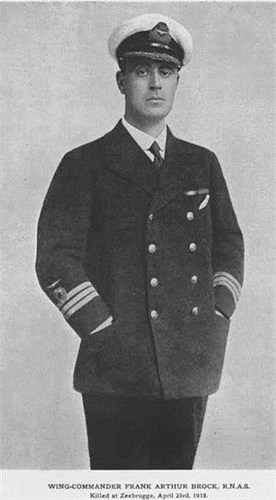
Today marks the 96th anniversary of the Zeebrugge raid, a daring but near-suicidal attempt by the British to block the canal entrance at the German-held port of Zeebrugge, to stop German U-Boats entering and exiting the canal into the north sea. One of the key players in the raid was Wing Commander Frank Brock.

Frank Arthur Brock was born on 29th June 18Frank Arthur Brock84 in Norwood. His father was the owner of Brocks fireworks, a long-established company (founded in 1725) that until 1932 had a 280-acre headquarters and factory in Sutton. During the First World War the factory was naturally utilised for the production of munitions.

Frank attended Dulwich College until 1901, after which he joined his father’s firm. He was a prolific inventor and naturally focused on pyrotechnics. When war broke out he applied for a commission initially in the Royal Artillery, but on 1st January 1915 he was appointed Flight Lieutenant in the Royal Naval Air Service. His scientific expertise was obviously noted as in December 1916 he was given the rank of Flight Commander, and was promoted to Wing Commander in April 1917 ‘in consideration of very valuable services performed for naval and military air services.’ Brock served on the ‘Board of Inventions and Research’ and worked at the Royal Naval Experimental Station at Stratford. His service record notes he had an extensive knowledge of chemistry and physics and an ‘exceptional talent for devising and perfecting new devices for use during war. Very capable, hard-working and zealous officer.’ He was specially mentioned by the War Office ‘for valuable assistance rendered to RFC in connection with destruction of Zepps’; this was for the invention of the Brock incendiary bullet, designed to ignite the gases contained within the envelope of the zeppelin airships. He also invented the ‘Colour Filter’, ‘Dover Flare’ (used by anti-submarine patrols), and stars that were used in Verey pistol cartridges. He was awarded an OBE in January 1918.

Brock's smokescreen being tested.

Brock’s smokescreen being tested.

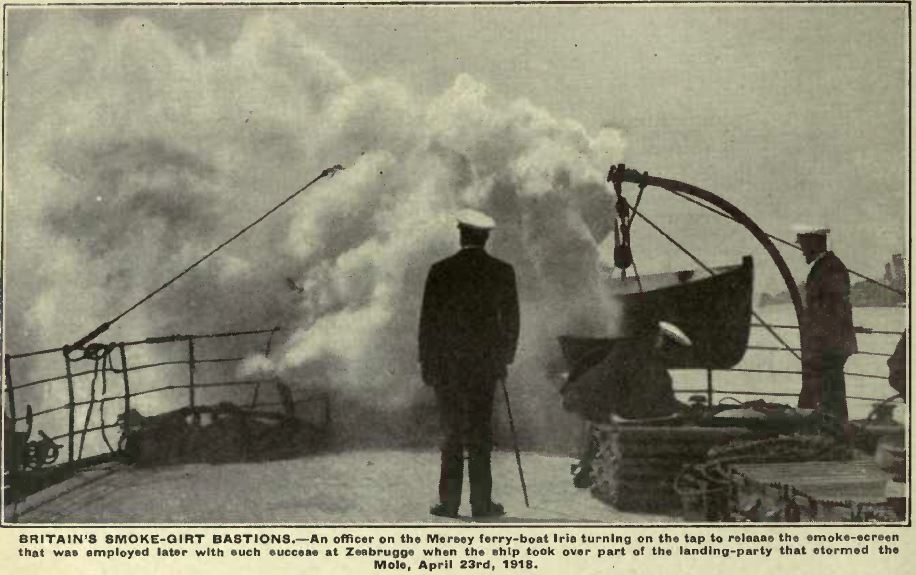
The plan for the Zeebrugge raid necessitated the use of submarines filled with explosives, two ferries requisitioned from Liverpool, and several old cruisers including HMS Vindictive. Zeebrugge harbour and the canal entrance were shielded by a long mole that arced across the canal entrance. This had naturally been utilised by the Germans as a defensive position, with gun batteries, machine guns, and garrisons of men stationed along it. Vindictive would land troops on the mole who would take out the shore batteries. The submarines would be blown up under the viaduct that connected the mole to the harbour, and blockships, filled with concrete, would then be manoeuvred into position and scuttled, blocking the harbour entrances. Brock’s role in the raid was in designing the apparatus that produced the smokescreen used by the ships to mask their approach.

The British force left from Dover and Harwich on the afternoon of April 22nd, some accounts stating that Brock had taken several bottles of vintage port on board Vindictive that were consumed during the crossing. The artificial fog smokescreen was deployed and was at first extremely successful in masking the arrival of the raiding force. However, a sudden change in the direction of the wind blew the cover away and the full weight of the German fire was opened on the approaching vessels. Despite suffering heavily, Vindictive managed to manoeuvre alongside the mole and put her remaining troops ashore. One submarine was exploded under the viaduct, and two blockships scuttled at the canal entrance.

The position of the ships during the raid.

The position of the ships during the raid.

The attacking troops paid a heavy price, and of the 1,700 who took part nearly 600 hundred were killed or wounded. German casualties were much lower, figures of eight killed and 16 wounded often being cited. One graphic account of the Vindictive’s return to Dover records ‘And there was blood. There were smears of blood high on the funnels. Half-congealed blood lay heel deep in the wrecked foretop, a mushroom-like box stuck up in front of the forward funnel. In that foretop pieces of skull and hair and skin were wedged into battered gun-sights, and it looked as though someone had sloshed buckets of blood on to the walls and ceiling. Below decks, and tucked in odd corners, there were torn clothes, boots, bandages and blankets, all dark and soggy with blood. The salt sea air had not been able to cleanse out the smells of gas, lyddite, cordite and blood.’

Brock’s fate during the raid is unclear. It seems he went ashore to try and locate German sound range-finding apparatus; a Warrant Officer who also took part in the raid stated Brock was ‘going singlehanded for a gun’s crew’. He was last seen with pistol and cutlass in hand on the mole, where he was ‘knocked out’.

The effectiveness of the raid was negligible, and the U-Boats were using the canal again within a few days of the raid. However, Zeebrugge was presented by British propaganda as a success, and eight Victoria Crosses were subsequently awarded.

Cheam war memorial

Cheam war memorial

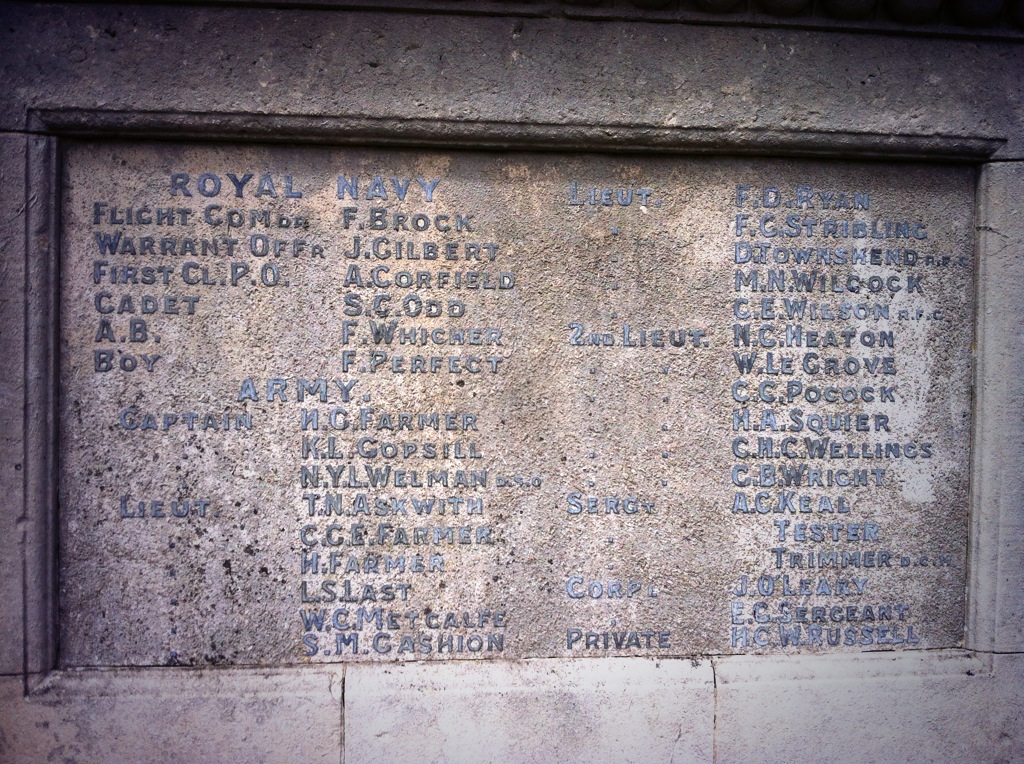
Frank was mentioned in despatches for the part he played. He has no known grave, although it is possible that he is one of the unknown officers buried in Zeebrugge churchyard, and is also named on the memorial there. In addition he is commemorated on Cheam war memorial, Dulwich College war memorial, a memorial in Brookwood Cemetery, and has a stained glass window dedicated to him at St. Saviour’s church, Raynes Park. He was a member of Malden golf club and each Armistice Sunday the club plays for the Brock Cup in commemoration. There is also a Brocks Drive in Cheam although I am unsure if this is named after Frank or his family.

Captain Alfred Carpenter, who was awarded the VC for his command of Vindictive during the raid, said ‘It would be difficult for anybody to speak too highly of Wing-Commander Frank A. Brock. He was a rare personality. An inventive genius, than whom the country had no better.’

Frank Brock's name on Cheam war memorial

Frank Brock’s name on Cheam war memorial

Henry Major Tomlinson, the writer and journalist who worked as an official correspondent for the army during the war, wrote of Brock: ‘A first-rate pilot and excellent shot, Commander Brock was a typical English sportsman; and his subsequent death during the operations, for whose success he had been so largely responsible, was a loss of the gravest description to both the Navy and the empire.’


Sources
Aero Club 14-18 Journal
Commonwealth War Graves Commission
Dulwich College Register
Fourteen Eighteen – John Masters
Pyrotechnics: The History and Art of Firework Making – A. Brock
The National Archives ADM service records
The Times
The War Illustrated

Posted in 1918, Gallantry, Navy, WW1 | Tagged , , , , | 1 Comment

Lives of the First World War – First Impressions

Over the past few days I have been trying out the beta of the Lives of the First World War database. This ambitious idea, being led by the IWM, is one of the flagship projects of the centenary. It will allow users to build up a picture of those who served during the war from official sources and user-submitted information and pictures, contributing to a permanent digital memorial.

Registering for the site is easy and simply requires a few details and clicking on a confirmation email to activate the account. The home screen (or ‘dashboard’) is clean and uncluttered with three simple guides to getting started, adding a life story, and finding a named individual. Once signed in, individuals that the user has ‘remembered’ are listed for ease of access.

Individuals can be searched by name, unit, or service number. Search results can then be filtered further by first name and surname, regiment, and rank. Once the correct individual has been found, their associated records can be updated. There are a number of options for information that can be updated, including information from official sources such as census and service records, as well as linking external information such as London Gazette entries. User-submitted information can also be added, including portraits or pictures of mementoes or links to websites. The focus is on ensuring the information provided is correct, and at each stage users are required to validate that the information they are connecting is relevant to that individual.

The current database of individuals within Lives of the First World War has been taken from The National Archives’ collection of medal index card (MIC) records, which has the inherent problem that it does not cover all the individuals who served in the war. However future additions will include the option of adding records for those who are currently not on the database, such as sailors, soldiers who did not serve overseas, commonwealth soldiers, and women who were working on the home front or as nurses. Another addition will allow individuals to be grouped by ‘community’, for example a club or war memorial, and presumably these will be searchable too.

Using the site has thrown up a few snags, but the beta provides users the opportunity to flag up any problems for investigation and response and certainly the ones I have reported have been responded to very quickly. There is also a forum to provide feedback and further ideas for improvement which other beta users can ‘vote’ for consideration to be acted on.

The true test of the database will be when it goes live and records are being accessed and updated by multiple users. Processes are in place to try and minimise incorrect information and conflicts, but we will have to wait and see how this works in practice.

The amount of time and resources being invested into the project is impressive and gives an indication of the commitment and drive of the IWM and those involved to make this succeed. Lives of the First World War has a lot of potential and will no doubt attract a huge amount of interest when it goes live and throughout the centenary period, and I for one am looking forward to seeing how it develops and contributing to the stories of those who served.

Posted in Centenary, Research, WW1 | Tagged , , , | Leave a comment