February battlefield trip – part 1

I have recently returned from a three day trip to the battlefields of the Ypres salient and the Somme with Steve Garnett of Battlefront Exploration (www.battlefrontexploration.co.uk ; @bfXsteve on Twitter). I hope to post a couple of blog articles with some of the photos from the trip over the next few days.
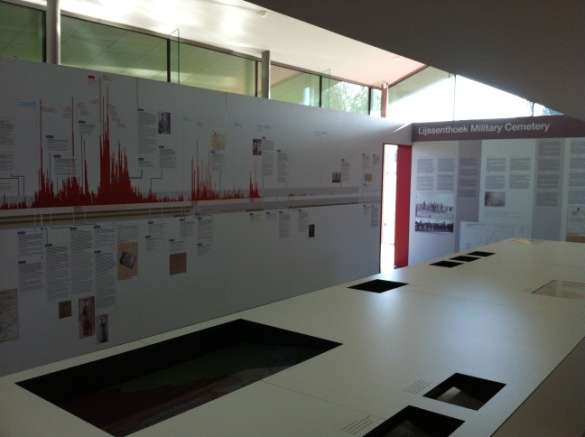
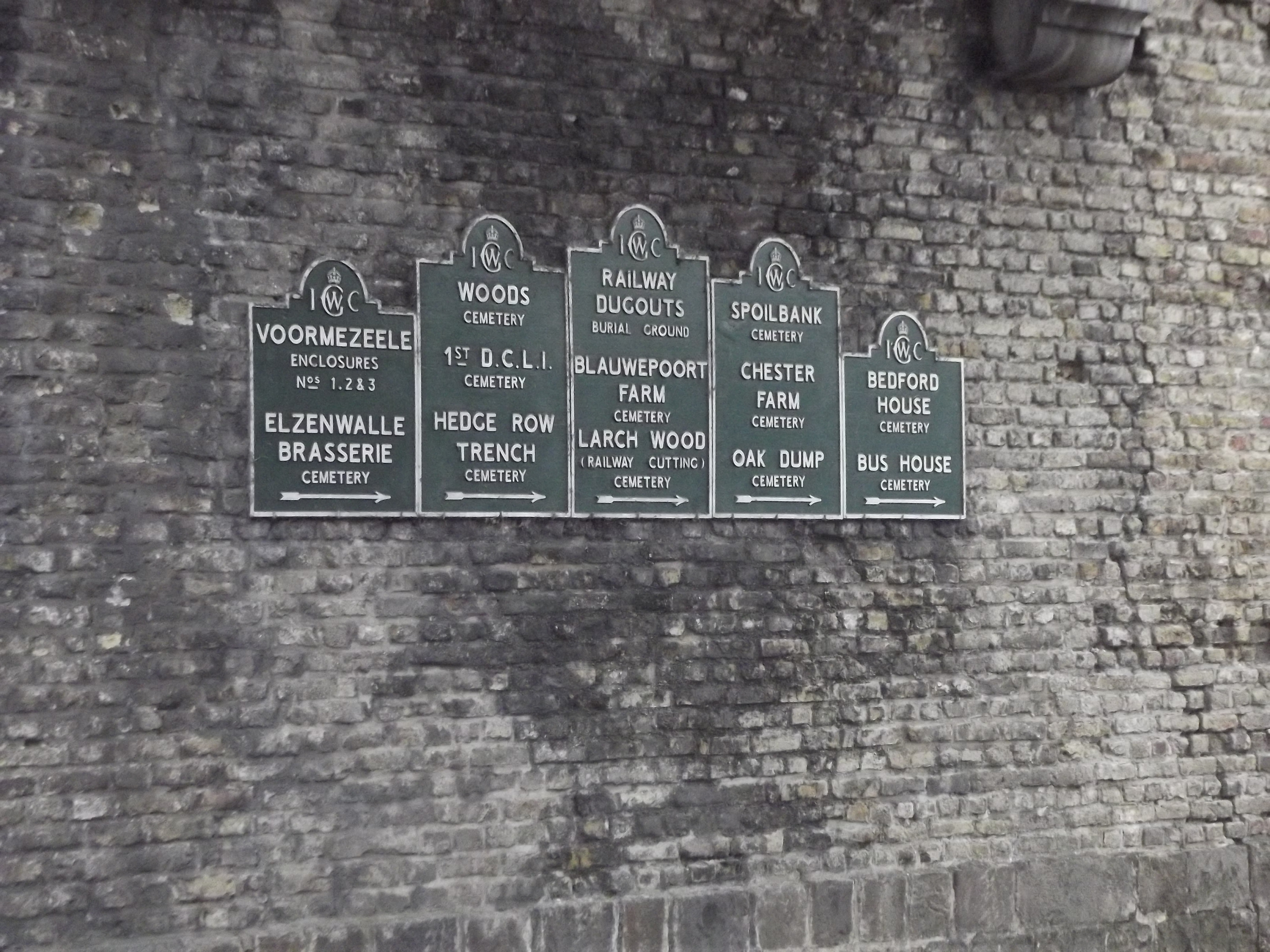
After an early crossing on the Eurotunnel and a smooth journey up to the salient we started by visiting Lijssenthoek cemetery. The new visitor centre is quite minimalist (echoing  the visitor centre at Tyne Cot), but some of the information is very informative, particularly the ‘timeline’ of the burials in the cemetery. They are carrying out a project similar to the one at Thiepval to collect information and photos about the men who are buried there, which is available to view at the visitor centre and online.

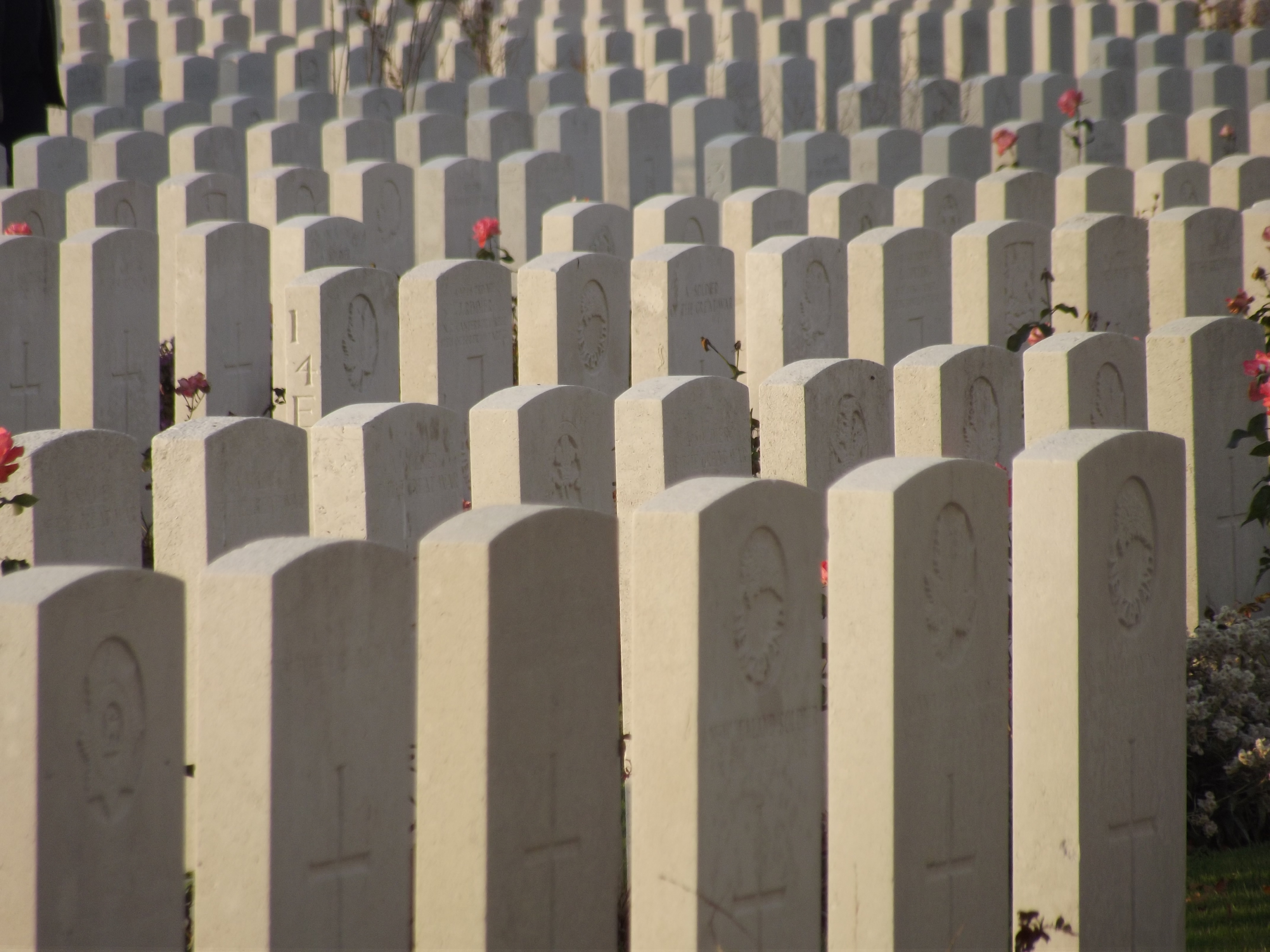
In the cemetery itself I was looking for the headstones of three men from Carshalton; my plan is to include the epitaphs from headstones (where they have one) in my book about the men. The headstone of Private James Jasper RAMC, for example, reads “Greatly beloved; deeply mourned”.

From Lijssenthoek we continued into Ypres itself, and headed straight to the revamped In Flanders Fields museum. The museum focuses on the Belgian experience of the war, which is understandable, but includes information on soldiers from all the major powers. Technology is well utilised and I found the graphics of the shifting front line particularly useful. The museum does not shy away from death, with some quite graphic pictures that certainly seemed to be grabbing the attention of the many school parties that were there. The highlight of the museum, however, is the opportunity to climb the 231 steps of the bell tower for a panoramic view of the salient itself. It is well worth the 2 Euros although quite a tight squeeze once you are up there! Information boards highlight points of interest, such as Hill 60 and Tyne Cot, and you really get a sense of how flat the landscape is; the rise of the Passchendaele ridge barely perceptible.

After a quick stop at Canada Farm cemetery we drove towards Westrozebeke, a small village north of Passchendaele. It was near here that my Great Great Uncle William MacDuff  had been killed in action on 2nd December 1917. It was finding out about him that really sparked my interest in the First World War, and visiting where he died was the culmination of a great deal of research into his life and death. Whilst the Passchendaele campaign officially ended on 10th November 1917, operations continued into early December to try and take the northern tip of the Passchendaele ridge. A night attack was carried out on 2nd December involving battalions from two divisions; my Great Great Uncle was one of the 1,687 men who were killed, wounded, or missing that night.

Using aerial photos, trench maps, and operation orders, I had been able to locate the exact area over which William’s battalion, the 11th Border Regiment, had attacked – an area of about 250 yards by 400 yards. Actually seeing the ground really helped to put the attack in context. The battalion’s jumping off point was a depression in the ground; they advanced up a slight ridge and at some point William MacDuff was shot by a machine gun. The battalion were able to take their objective, Mallet Copse, but had to retire due to enemy fire. The copse is now gone but I was able to stand at what would have been the edge, and look across the ground William and his men would have advanced over. 

Standing at the southern edge of Mallet Copse; the 11th Border Regiment advanced over the ground behind me

William, along with 85 men from his battalion who were killed that night, have no known grave. The fact that they may still be lying under the ground I was standing on was particularly poignant.

Some evidence of the war was still visible; an 18 pounder shell, a stokes mortar, and numerous lumps of rusted metal. A plaque and tree to a Private of the 16th Highland Light Infantry, who advanced to the right of the Border Regiment, is the only other indication that the area was fought over.

Image

Plaque beside the tree dedicated to Private Hugh Cairns, 16th HLI

After this is was only fitting that we visit Tyne Cot, where William’s name appears alongside nearly 35,000 others who are missing.

We headed back to Ypres via Gheluvelt, scene of the dramatic counter-attack by the 2nd Worcesters on 31st October 1914, and the 18th Division memorial at ‘Clapham Junction’.

Our last tip of the day was to attend the Last Post ceremony under the Menin Gate. The ceremony never fails to move me, and having been following William’s last moments during the day, was particularly touching. The following morning, we headed south towards Loos and the Somme.


Part 2 to follow…


Posted in Uncategorized | Tagged , , , | 1 Comment

2012 in review

Below is a short WordPress report on my blog’s stats in 2012. Given that I only started it in May I have been amazed by the number of views it has had. Due to other commitments I haven’t been able to post as I much as I would like to but I hope to rectify that this year. With an upcoming trip to the battlefields, visit to the archives, and a stack of books to review, hopefully I will have lots to blog about! Thanks to everyone who has taken an interest so far.

Here’s an excerpt:

The new Boeing 787 Dreamliner can carry about 250 passengers. This blog was viewed about 1,300 times in 2012. If it were a Dreamliner, it would take about 5 trips to carry that many people.

Click here to see the complete report.

Posted in Uncategorized | 1 Comment

The 1st Queen’s At Gheluvelt

“October 31st and November 1st will remain for ever memorable in the history of our country, for, during those two days, no more than one thin and straggling line of tired-out British soldiers stood between the Empire and its practical ruin as an independent first-class Power.” (John French, 1914).

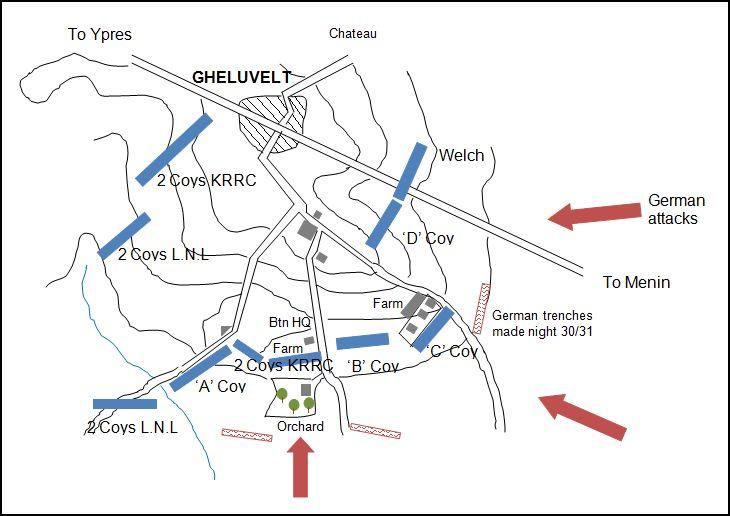
The 31st October 1914 saw the Battle of Gheluvelt, one of the battles of First Ypres. Well known for the actions of the 2nd Worcesters, who retook the chateau and the village after they had been captured by the Germans, several other battalions were also involved, including the 1st Battalion The Queen’s (Royal West Surrey Regiment).

The importance of Gheluvelt was paramount. Sitting on a ridge the Menin Road, it was the last bastion of defence before Ypres. If the Germans broke through here, they could take Ypres and move on to the channel ports.

The 1st Queens had landed at Le Havre on 13th August. As part of the 3rd Brigade, 1st Division, they had seen plenty of action, most recently on 23rd October near Langemarck. Casualties that day were 17 killed, 39 wounded, and 89 missing. In total, since landing in France, the battalion had suffered 58 killed, 264 wounded, and over 130 missing. Casualties among the officers were particularly high, with 24 killed and wounded by 29th October. On that day the battalion moved into trenches east of Gheluvelt, two further officers becoming casualties. The following day was fairly quiet, although the line was shelled throughout the day. At 7pm an attack on ‘C’ Company was repulsed, although sniping continued throughout the night.

Map of the battle based on a sketch by Major Watson

The morning of the 31st October opened with a pre-dawn attack towards the two farms held by the Queen’s. The Germans were unsuccessful, however shelling continued throughout the morning.

In a second attack the Germans managed to take the Orchard, driving out one platoon of the 1st Queens and one of the 2nd KRRC. A counter-attack was ordered by the commanding officer of the Queen’s, Lieutenant-Colonel Pell, but an attempt by the KRRC failed. Major Watson went back to seek assistance and on his return found Lieutenant-Colonel Pell had been wounded; hit in the leg, which had been broken. Major Watson assumed command. By 10am ‘B’ Company had been driven from their line by heavy machine gun flanking fire. By 11am both ‘B’ and ‘C’ companies were retiring. ‘D’ Company were given the order to retire but it soon became apparent that Gheluvelt itself had been taken and the Germans were moving in behind them. Major Watson and Second Lieutenant Boyd tried to reorganise the remaining troops around the junction south of Gheluvelt, holding the area for the remainder of the day.

In the meantime the 2nd Division had been brought up, and retook Gheluvelt in the afternoon. This is when the 2nd Worcesters carried out their famous bayonet charge, linking up with the remains of the 1st South Wales Borderers and driving the Germans out of the chateau and the village. The threat to the British line had been averted at the last minute.

The following day, only 32 men from the 1st Queen’s could be accounted for. ‘A’ Company had 24 men remaining; ‘B’ Company four; ‘C’ and ‘D’ Companies just two men each. Major Watson and Lieutenant Boyd were the only officers who had come through unscathed. The battalion, consolidated with remnants of the other battalions who had fought in the action, remained in the line until 8th November.

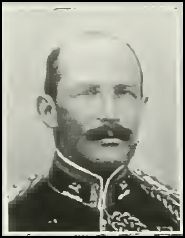
Lieutenant Colonel Pell

In total nine officers and 624 other ranks had been killed, wounded, or were missing. They included Lieutenant-Colonel B.T. Pell, DSO, the battalion’s commanding officer; unable to move due to his broken leg and the heavy shellfire, he was in the farm with the Medical Officer when it was rushed by the Germans. He would die as a prisoner of war on 4th November. The CWGC database records 180 deaths in the battalion during this period. Of these, over 75% have no known grave and are commemorated on the Menin Gate memorial.

Accurate German artillery fire, effective use of machine guns, and the fact that the tired and depleted British were facing a number of fresh German battalions, all contributed to the near-breakthrough by the Germans that day. The 1st Queen’s had fought tenaciously and suffered heavily; in the words of the regimental history “October 31st was one of the worst days experienced by the 1st Battalion during the whole war.”

Sources
1st Battalion war diary
Bond of Sacrifice
CWGC
Wylly, HC – History of The Queen’s (Royal West Surrey) Regiment in the Great War

Posted in Surrey Regiments, WW1 | Tagged , , , , | 18 Comments

‘Thomas Hardy’ of Festubert

Whilst searching for biographies of officers of The Queen’s (Royal West Surrey) Regiment in The Times, I came across a story that grabbed my attention entitled ‘Thomas Hardy of Festubert’.

The story begins with an incongruous entry in the London Gazette, 4th June 1915:

‘The King has approved the removal from the Service of the undermentioned Officer of the Indian Army:- Captain Hugh Sale Smart. Dated 29th December 1914’

Hugh Sale Smart was born on 3rd February 1885 in Kurnool, India, where his father Alexander was a Colonel with the Royal Engineers. Hugh was educated at Clifton College, Oxford, as well as spending time in Germany and being tutored privately. In 1904 he applied for a commission, and on gaining this in August 1905 was appointed to the South Staffordshire Regiment. After two years he transferred to the 53rd Sikhs, and thereafter also spent time with the Khyber Rifles on the Afghan frontier.

Serving on the Indian frontier when war broke out, he made three applications to rejoin his old regiment, but on each occasion was turned down. In December 1914 he was granted leave but when it expired, failed to rejoin his regiment. This subsequently led to his dismissal. It appears that, desperate to see action, Hugh had instead travelled back to England. There he enlisted as a Private in the 2nd Battalion The Queen’s (Royal West Surrey) Regiment, under the alias ‘Thomas Hardy’. Here his story may have ended, but for his death at Festubert in May 1915.

In May 1915 the 2nd Queen’s were part of the 22nd Brigade, 7th Division. Also in that Brigade was the 1st Royal Welsh Fusiliers. It seems that ‘Private Hardy’ was attached to them for training in bomb throwing. On 16th May, in the attack at Festubert, the bombing parties were heavily utilised in clearing the networks of German trenches. For his efforts during this action Company Sergeant Major (later Lieutenant) Frederick Barter of the Royal Welsh Fusiliers was awarded the Victoria Cross. The true story of ‘Thomas Hardy’, as one of the volunteers who assisted Barter, came to light soon after. The following extract is taken from Deeds That Thrill the Empire:

“Hardy was a man of splendid physique, obviously a gentleman, and so proficient in his military duties that Barter, with whom he soon became on intimate terms, began to suspect that he was an officer who had left the service possibly under a cloud, and had enlisted under an assumed name. His suspicious proved, in the main, to be correct, for one day ‘Hardy’ admitted to him that his real name was Smart, and that he had been a captain in the 53rd Sikhs, and that, being on leave in England at the time when war broke out, he had decided not to return to India, but to join a British regiment as a private in order to make sure of getting to the front. He begged Barter to keep the fact a secret while he lived, but, should he be killed in action, he might then consider himself at liberty to make it public. In the bomb attack, Private ‘Hardy’ showed such splendid courage that, in Lieutenant Barter’s opinion he would, had he survived, have certainly awarded the Distinguished Conduct Medal. “He was,” said he, in conversation with a representative of a London paper, “about ten yards from the first German trench when he got wounded. It was a terrible blow in the right shoulder. Some of our men bound up the wound, and I shouted, ‘Hardy, go back!’ I could see, however that he was determined to go at the enemy. ‘Hardy’ answered: ‘It’s all right, for I am left handed.’ The next thing I saw was ‘Hardy’ rushing off to our right, and, with the bravery which seemed his characteristic, he commenced to slam the bombs at the enemy. He carried on like that for about twenty or thirty yards, and he was eventually shot through the head, half of which was blown off. He died a hero’s death, and no one regretted his end more than I did, for I was probably attached to him more than anyone else, and was afforded opportunities of seeing his sterling worth. Hardy was a man of splendid physique – I should say he was quite six feet high, and there can be no doubt of this, that he was six feet of real manhood. A more fearless fellow it would be impossible to find. We all loved him. I have never seen a happier man. He seemed to live to beat the Germans.”

Following his death it seems that word of Private Hardy’s true identity soon reached the War Office. His service record at The National Archives contains a letter that states: ‘The General Officer Commanding IV Corps [Rawlinson] said Private Hardy was recommended for the Victoria Cross and notwithstanding the fact that he made a false answer on attestation he strongly recommended him for a posthumous Victoria Cross. The Adjutant General, British Army in the Field, forwarded the correspondence for such action as might be desirable, but it was ascertained that the F.M. C-in-C did not recommend the issue of the Victoria Cross and that had Private Hardy lived he would have been granted the Distinguished Conduct Medal.’

The issue of Captain Smart’s dismissal from the Indian Army was obviously discussed at a high level, and the following notice appeared in the London Gazette, 6th August 1915:

‘The King has approved the cancellation of the removal from the service of Captain Hugh Sale Smart, Indian Army (killed in action 17th May, 1915), which was notified in the London Gazette of 4th June, 1915, with effect from the 29th December, 1914.’

Hugh Smart’s body was never recovered and he is commemorated on Le Touret memorial. He has two entries on the CWGC database, one in his correct name and one under his alias:

http://www.cwgc.org/find-war-dead/casualty/857463/

http://www.cwgc.org/find-war-dead/casualty/75191753/


Sources
Commonwealth War Graves Commission
Deeds That Thrill the Empire
London Gazette
The Illustrated War News
The National Archives
The Times

Posted in Festubert, Surrey Regiments, WW1 | Tagged , , , , | Leave a comment

The Battle of Loos

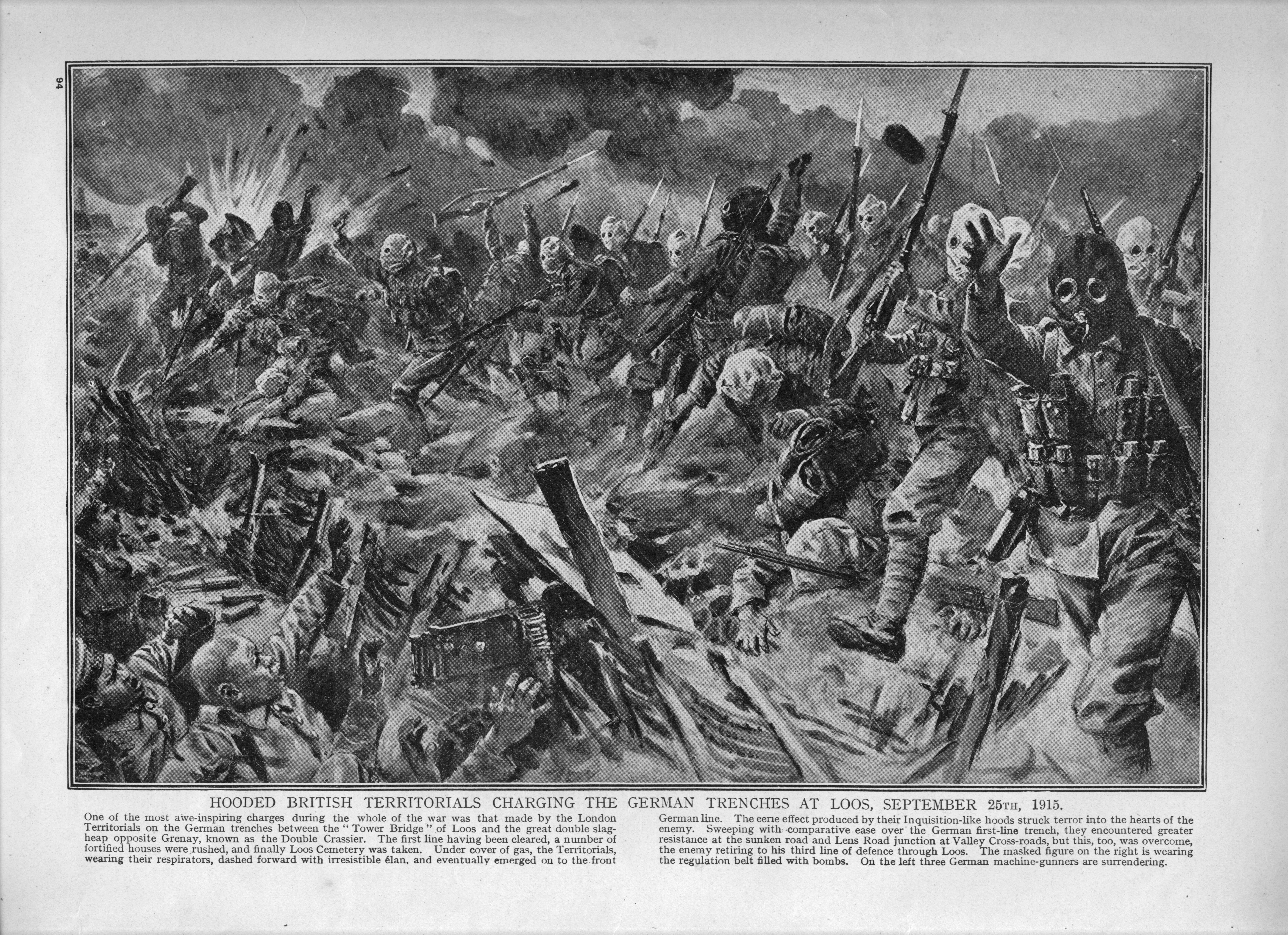
Today marks the 97th anniversary of the start of the Battle of Loos, the British ‘big push’ of 1915. The battle was the first time some of Kitchener’s volunteers saw action – for many it would also be the last. These volunteers included men from the 8th Battalion, The Queen’s (Royal West Surrey) Regiment, and the 9th Battalion, East Surrey Regiment, who had only arrived in France on 31st August as part of the 24th Division. They were held in reserve and went into action on the second day of the battle near Hulluch. The war diary entry of the 8th Queen’s simply states:

“The battalion advanced under heavy machine gun and shrapnel fire in lines of platoons in extended order. As the advance continued over the Lens – La Bassee road, the machine gun fire from the flanks was very heavy. On reaching the enemy trenches it was found to be protected by barbed wire, which had not been cut and it being impossible to get through it, the brigade retired. There appeared to be no panic & the men walked back still under machine gun and shrapnel fire.”

This entry belies the chaos of the attack – both the 8th Queen’s and the 9th East Surreys suffered heavily due to the uncut wire and the German machine gun fire; between them they suffered 872 casualties.

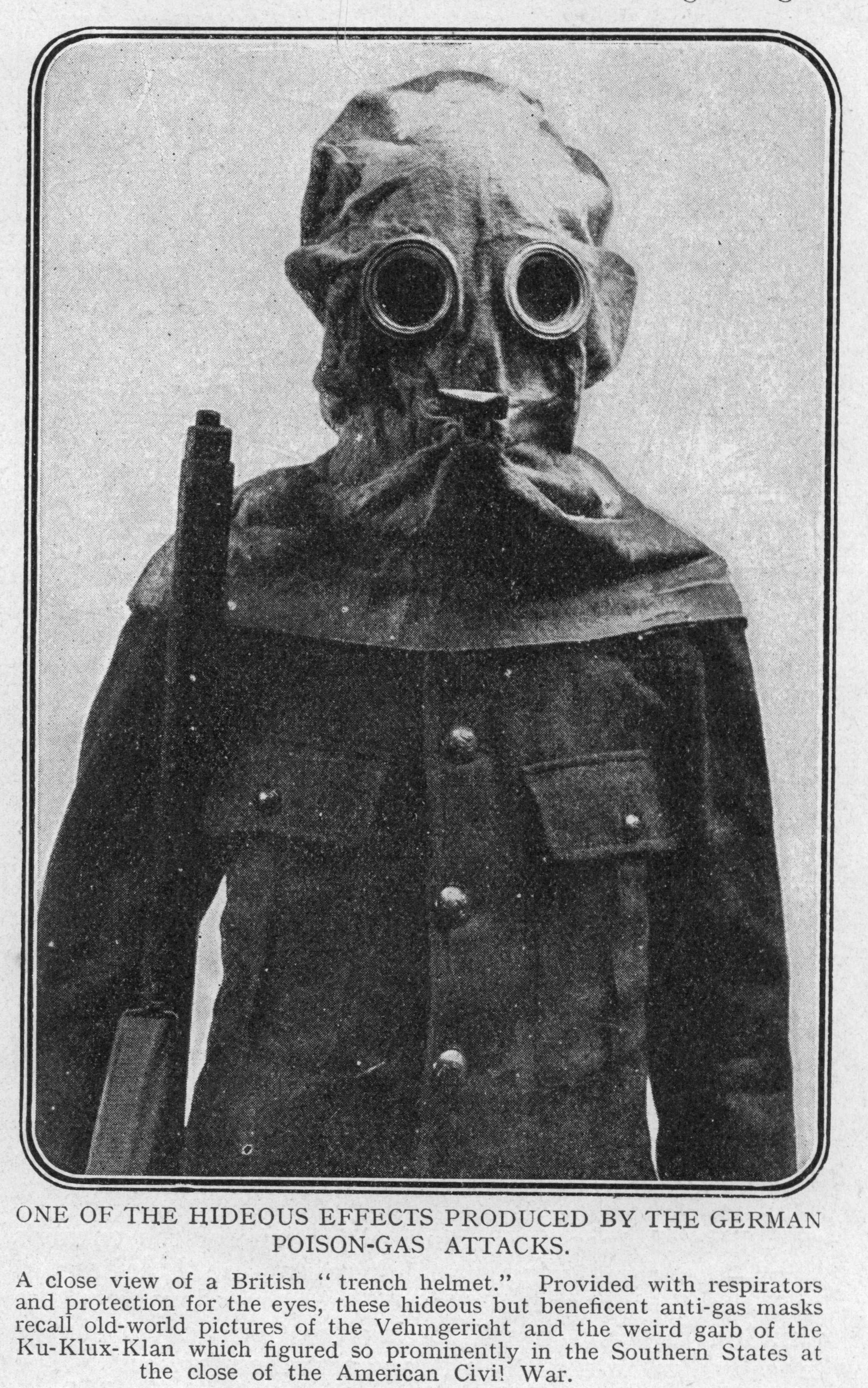
The Battle is also notable for the first British use of gas. Chlorine gas, a powerful irritant that can be lethal, was released from cylinders along the front line, but with mixed results. Whilst in some places the gas did drift towards the Germans, in other areas it hung over no man’s land or even drifted back into the British lines, causing casualties to the attacking force.

The following extract justifying the British use of gas is taken from one of the weekly publications that appeared during the war – The Great War: the Standard History of the all-Europe Conflict, edited by H.W.Wilson. In total there were 272 parts, and over 41 million copies were sold. They were full of patriotic, morale-boosting articles and supplemented by photographs and sketches. This issue was published in early December 1915 and is entitled ‘The Great Drive in the West and the Battle of Loos’:

“So heavy were the disadvantages of the Allies in attacking against hidden machine guns and deeply entrenched troops, provided with huge magazines of bombs, that there was only one means of overcoming the difficulties in the way of an infantry attack. This means was a gas cloud. If the Germans had not stooped to chemical weapons of torture during their second thrust at Ypres, their own position in the west would have remained stronger. But from April, 1915, they had continued to use asphyxiating and poison gases in so general a way that the Allies were at last compelled in self defence to adopt a similar method. Nevertheless, the British and French commanders were even then able to show the difference between the methods of neo-barbarism and those of the warlike forces of civilisation. The enemy at the time was using the deadliest poison that could be manufactured on a large scale – prussic-acid gas. But the French and British chemists provided their armies with merely an intoxicating stupefying mixture of heavy gases, which put the Germans out of action, and did not kill our own troops if the wind suddenly changed. As a matter of fact, there were cases of British soldiers being suddenly overcome by their own fumes. The result was only longer sleep, an orange-coloured face, and a little discomfort on awakening. There was an avoidance of that moral effect of making men afraid of their own chemical weapons, which had clearly been seen in hesitating advances of the German infantry at Ypres in the previous April, and yet the direct aim of putting deeply-entrenched defending troops out of action was attained.”

Posted in Gas, Loos, WW1 | Tagged , , , , , , , | 5 Comments

Armistice Day in Ypres

Last November I travelled to Belgium with Leger Holidays on their ‘Armistice Day in Ypres’ tour. The reason for this was primarily to visit Tyne Cot for the first time, where my Great Great Uncle, William MacDuff, is commemorated. However as I had not visited the area before it was also a chance to see some of the other sites of the ‘immortal salient’.

After a smooth crossing and short drive we arrived at our hotel in Menin, just down the road from Ypres, and met our guide Peter Williams, who ably led the tour over the next two days. The following day, Friday 11th November, saw an early start to head into Ypres itself for the Armistice commemorations. Arriving at about 9am the area around the Menin Gate was already packed, and by the time the ceremony began there was barely room to move. For those who could not reach the Gate the proceedings were also shown on a big screen in the Grote Markt, in the shadow of the imposing Cloth Hall. The ceremony itself was very moving; the two-minute silence carefully observed by the crowd, and the haunting notes of the Last Post lingered in the air – a very emotive experience.

Following the ceremony we walked around the sturdy town walls, stopping at places of interest such as the Lille Gate and the Ramparts cemetery. We also had a chance to visit the ‘In Flanders Fields’ museum before it closed for refurbishment. The museum has now been considerably revamped and also now offers visitors the opportunity to survey the battlefields from the top of the bell tower.

I returned to the Menin Gate and sought out the names of the nine men from Carshalton whose names are inscribed upon it. It is a magnificent structure, and like Thiepval hard to comprehend the number of names that adorn its panels.

Some free time meant that I was able to visit Ypres Town Cemetery where a further two of Carshalton’s casualties, Ernest Baker and Reginald Chandler are buried; I was the only visitor and after the throng of people at the Menin Gate it was nice to have some solitude and time to reflect. After dinner in one of the many restaurants that line the Grote Markt, the final event of the day was to witness the evening’s Last Post ceremony, the Menin Gate almost as crowded as it had been earlier in the day.

The next day was spent visiting some of the sites in the area, including Polygon Wood, Caterpillar Crater & Hill 60, Hooge Crater museum and cemetery, Essex Farm, the Passchendaele Memorial Museum, and the Aristocrats Cemetery in Zillebeke.

However the highlight of the day for me was the visit to Tyne Cot and seeing William’s name on the memorial wall, taking some comfort in the fact that although he has no known grave, he is remembered alongside his fellow soldiers who also lost their lives in the same action. Seven men from Carshalton are also commemorated among the 34,952 who died in the salient after 16th August 1917. Looking west over the field of headstones the panoramic view belies the formidable field of fire the Germans must have had from their pillboxes over the gently falling ground.

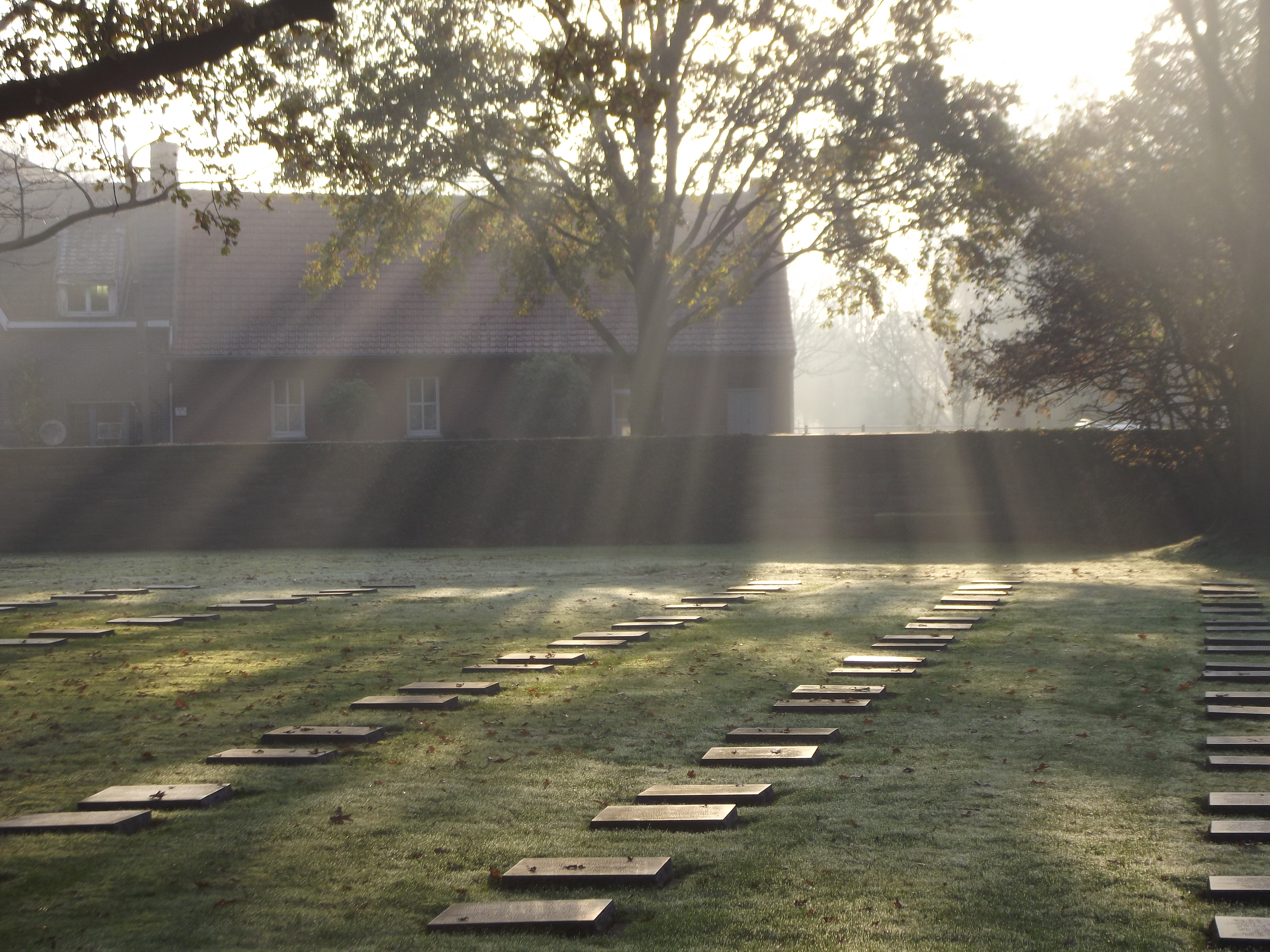
On the last day before the journey back we just had time to visit the German cemetery at Menin. With the early morning sun filtering through the trees the atmosphere was eerily quiet, and it was hard to envisage that the remains of 48,000 men are buried under the low grave markers, making this the largest military cemetery in Flanders.

Overall I found the trip extremely fulfilling. It managed to fit a great deal in to the two full days spent in Ypres and the surrounding area, but at no point were we made to feel rushed. Our guide Peter was knowledgeable and took the time to speak to everyone on the coach. It was a great introduction to the Salient, and I look forward to returning in the future.

Details of this year’s Armistice Day in Ypres tour, 9th-12th November.

Posted in Battlefield tours, WW1 | Tagged , , , | 2 Comments

Colonel HC Wylly

In carrying out research I am always looking for new sources to draw upon. The internet is a fantastic resource, and with websites such as Ancestry and the Great War Forum, a large amount of research can be done from the comfort of your own home.

Regimental and battalion histories are a valuable resource for the student of the First World War. As well as detailing the movements and actions of a battalion or regiment, they often contain rolls of honour, photographs of men, and lists of decorations bestowed upon the soldiers. Due to the expiry of copyright, many of these histories are available to download on the internet for free from sites such as archive.org. Others have been reprinted by publishers such as Naval & Military Press.

A prolific author of such histories was Colonel HC Wylly. An internet search will bring up many of his books, but there is not much information about the man himself.

Harold Carmichael Wylly was a career soldier. Born in Meerut, India, in 1858 he attended Henley Grammar School and Wimbledon School before entering Sandhurst. In 1878 he was gazetted to the 95th Regiment and served in the Anglo-Egyptian war (1882), the Sikkim expedition (1888), the Tirah campaign (1897-1898), and the South African war, after which he was made a Companion of the Order of the Bath (CB).

He appears to have started his writing around the time of the South African War, publishing ‘The 95th Regiment in the Crimea’ in 1899. Several publications followed before the outbreak of the First World War, where Wylly commanded the 1st Battalion Sherwood Foresters, Nottinghamshire and Derbyshire Regiment. His daughter Beryl, an aspiring actress, later married Valentine Penna, also an actor, who had served in the Artists’ Rifles from 1915-1918.

In 1913 Wylly had been appointed editor of the Royal United Services Institute journal, a position he held until 1923. During his time as editor he was instrumental in creating the library catalogue. Post-war his literary output increased, and he authored several wartime battalion and regimental histories. In his obituary The Times wrote “These are admirable records, prepared with scholarly care and judgement, and will be of permanent value to future historians.” I have certainly found his history of The Queen’s (Royal West Surrey) Regiment invaluable during my research into the men named on Carshalton’s war memorial.

Below is a list of Wylly’s known publications:

A Cavalry Officer in the Corunna Campaign 1808-1809: the Journal of Captain Gordon of the 15th Hussars

A History of the XVth Hussars

A Short History of the Manchester Regiment (Regular Battalions)

From the Black Mountain to Waziristan

History of the King’s Own Yorkshire Light Infantry 1755-1914, vol. 1

History of the King’s Own Yorkshire Light Infantry 1755-1914, vol. 2

History of the Queen’s Royal Regiment

Neill’s “Blue Caps”, vol. 1

Neill’s “Blue Caps”, vol. 2

Neill’s “Blue Caps”, vol. 3

The 1st and 2nd Battalions, the Leicestershire Regiment in the Great War

The 1st and 2nd Battalions, the Sherwood Foresters (Nottinghamshire and Derbyshire Regiment) in the Great War

The 95th (The Derbyshire) Regiment in the Crimea

The Border Regiment in the Great War

The Campaign of Magenta and Solferino, 1859

The Green Howards in the Great War

The Life of Lieutenant-General Sir Eyre Coote

The Military Memoirs of Lieut.-General Sir Joseph Thackwell

The York and Lancaster Regiment, the Territorial and Service Battalions, 1758-1919

Posted in Uncategorized | Tagged , , | 2 Comments

May you sleep well in the earth of beautiful France

Corporal William Stuart Barnett, KIA 7.9.14

William Stuart Barnett was born in Sutton, Surrey, in 1892. His father, a jeweller and silversmith, died when he was just three years old. After leaving school William worked as a Pawnbroker’s assistant and joined the army in 1910. He initially served with the London Regiment (9th Battalion, Queen Victoria’s Rifles), where he was promoted to Lance Corporal in 1912. He transferred to the Royal Engineers in May 1914 and was among the first troops to land in France in August.

William was killed in action at Doue, 50 miles east of Paris, on 7th September 1914 while carrying despatches from General Headquarters to the Second Army Corps Signals. The Reverend O.S. Watkins, a Chaplain during the war, wrote of William in his book ‘With French in France and Flanders’: “I found the brave lad lying in a cottage in the village. Peasants told me that in the darkness he had lost his way, and had actually ridden through two villages occupied by the Germans until he was brought to a stand at Doue with a bullet through his heart. As soon as the Germans retired the villagers had lifted him tenderly into the cottage, straightened his fine young limbs into decent restfulness, and covered him with a clean white sheet. I found him, a bunch of newly gathered flowers on his breast, his face calm and determined, but looking strangely young. He was carried to his last long rest by old men belonging to the village – there were no young men, for all were serving with the Army – and as we passed through the streets women came from the houses and laid flowers upon the bier. Up the steep road we toiled, with many a stop to rest the ancient bearers. Ahead boomed the heavy guns in action, and below we could see the infantry advancing to the attack. At last we reached the hill-top, crowned by its little church and peaceful graveyard. We laid him in his shallow grave, the peasants, with heads uncovered, listening with reverence to the grand words of the Burial Service in a language they did not understand. Before the service was over shrapnel was bursting on the hill, and silently the peasants crept to the wall for shelter, their heads still uncovered.

As the final ‘Amen’ fell from my lips, and I stood for a moment looking down on all that was left of that fine young manhood, one of the old men, forgetting his fear of the thundering guns, stepped to the graveside, and, as he cast earth upon the prone body with his hands, with wonderful dignity he addressed the sleeper. As far as I could understand his words he said: ‘You are a brave man and our friend. You have given your life for our country. We thank you. May you sleep well in the earth of beautiful France’, and the others said ‘Amen’.”

William remains buried in Doue churchyard, the only Commonwealth burial located there. He is also commemorated on Sutton war memorial.

Posted in WW1 | Tagged , , | 4 Comments

The Youngest Lieutenant Colonel

Eric Gordon Bowden was killed on 22nd July 1918. At the time of his death he was Lieutenant Colonel of the 11th Battalion The Queen’s (Royal West Surrey Regiment), aged just 24. His Commonwealth War Graves Commission entry reads “Lt. Col. Bowden’s headstone is engraved as a special layout containing the following additional information : “Age 24. Born 12th May 1894. Promoted on the field of action from 2nd Lieutenant, he was one of the youngest Colonels in the British Army.” He has at all times set a fine example” (Gazette).”

Eric was born and lived in Nunhead. He attended Alleyn’s school, leaving in 1909 to become a clerk for a civil engineer. He served from November 1914 to February 1915 in the Alleyn Volunteer Training Corps, which was then disbanded. In July 1915 he applied for a commission, and left Aldershot with his battalion on 3rd May 1916, arriving in France two days later. Their first action was consolidating the position around Flers after the successes of 15th September, and they saw further action around Mametz Wood. He was promoted to Acting Captain in September, with a further promotion to Major in August 1917. In the meantime the battalion had seen action at St. Eloi and Westoutre, and on 24th March 1917 he had been presented with the Military Cross by the Divisional General, Major General Lawford. His citation in the London Gazette (02/03/17, p.2192) reads “Temp. Lt. (actg. Capt.) Eric Gordon Bowden, R.W. Surr. R. For conspicuous gallantry in action. He led a successful raid against the enemy’s trenches with great gallantry, and inflicted many casualties. He has at all times set a fine example.”

In November 1917 the battalion moved to Italy, returning to France at the beginning of March 1918. At the onset of the German March offensive the battalion was in the Somme area, and suffered nearly 380 casualties over the following two days. On 5th April they moved to Ypres, where Eric took over command of the battalion. However, his command was not to last long, and the battalion war diary records his death on 23rd July (as opposed to 22nd on CWGC): “Batt front very quiet during the day…Major E.G. Bowden MC killed about 12 noon riding through Steenvoorde.” Steenvoorde lies about 16 miles west of Ypres, well behind the lines, so the cause of death can presumably be attributed to shell fire. His grave was likely to be one of those moved after the Armistice, as he was originally buried in Steenvoorde Military Hospital Cemetery, at Hazebrouck.

Although just 24, Eric Bowden was not in fact the youngest Lieutenant Colonel to lose his life in the war. A check of the CWGC database reveals this to be Lieutenant Colonel John Hay Maitland Hardyman, killed on 24th August 1918 aged 23. A graduate of Edinburgh University, he served with the 8th Somerset Light Infantry and had been awarded the MC and DSO. His MC citation (London Gazette 18/07/17, p.7231) reads “For conspicuous gallantry and devotion in several dangerous reconnaissances, in one of which he was wounded. He displayed great bravery in organising the clearance of wounded from a medical aid post near an ammunition dump, which had been set on fire by a shell.” His DSO citation (London Gazette 15/10/1918, p.12054) reads: “For conspicuous gallantry, and devotion to duty. After the enemy had penetrated the line in three places he went forward through a heavy barrage to the forward posts, rallied the garrison, and encouraged them by his coolness and absolute disregard of personal danger to successfully repel repeated enemy attacks extending over two days and three nights. Thanks to his gallant leadership and endurance, the position, which was of great tactical importance, was maintained.” He was promoted to Lieutenant Colonel in May 1918, however like Eric Bowden, he was killed just three months after taking command. On 24th August the battalion attacked and captured Biefvillers, to the north west of Bapaume. However, due to heavy shelling the position had to be evacuated. John was killed by a shell whilst carrying out reconnaissance. The Divisional Commander wrote “His splendid leadership and magnificent gallantry will never be forgotten.” Hardyman was a poet and a collection of his work can be read online. Some further information about him can also be found on the Great War Forum.

Ultimately it does not matter which of the two was the youngest Lieutenant Colonel; both were undoubtedly extremely brave and took on a burden of responsibility beyond their years.

Photo of Eric Bowden courtesy of Alleyn’s School archive. The school’s First World War roll of honour can be seen here.

Posted in WW1 | Tagged , , , , , | 1 Comment

Preparing for the Centenary

In a recent, rather rambling article for the Daily Mail, Max Hastings criticised the government’s apparent lack of interest (read: funding) in the centenary. However, I think that his assertion that “the British government is so eager to wash its hands of the coming 1914 centenary” is a little premature, particularly given that the Jubilee and Olympics have dominated the headlines and the public consciousness. But with 2014 fast approaching, what is being done in preparation for the centenary?

David Cameron has not been completely idle – last year he appointed Dr Andrew Murrison as the Special Representative to explore the commemoration of the centenary. At a meeting of the All-Party Parliamentary War Heritage Group in December last year (attended by representatives of the main organisations you would expect to be involved in the centenary plans) Dr. Murrison addressed the group. Key points were the importance of grassroots, community-based commemoration across the whole country (not just London), an inclusive approach with other countries, and education as the main legacy of the centenary. The Chairman of the group, Lord Faulkner, can be seen discussing the centenary here, and Dr. Murrison here. The religious commemoration of the centenary has also recently been discussed in Parliament. The Department for Culture, Media and Sport have started a blog about the centenary preparations; there is currently one blog entry by Diane Lees, Director of the Imperial War Museums. A discussion of whether the centenary should be celebrated or commemorated, and some of the challenges and tensions the centenary brings, can be heard on this podcast from the University of Birmingham.

Other organisations are not waiting for government direction or funding. The Imperial War Museum will be pivotal in the centenary and indeed their campaign has already started with the launch of their centenary website. One of the most exciting aspects for me is the redesign of their First World War galleries. I have been visiting the IWM since I was a child and never tire of the galleries and exhibits. But is this the end for the Trench Experience?!

The IWM have released few details about the redesign; their latest press release does, however, reveal that their revamped First World War galleries will be 45% larger than the existing ones. Some information can also be gleaned from the ‘Transforming IWM’ blog, webpage and galleries page. An indication of the ‘look’ of the redesigned museum can be seen in the architects’ visualisations and on their Justgiving page. Planning permission has been granted and if you are good at interpreting architectural plans some idea of the proposals can be seen in the planning application. The National Army Museum have also announced an upgrade, but there is no indication if any of this will tie in with the centenary.

Another key organisation will be the Western Front Association. There is currently no information on the WFA website about their centenary plans, although members will have read in the Bulletin/Stand To of the ongoing discussions about planning for 2014-18. The last update was late last year, where it was reported that a national calendar of events will be developed – this should prove very useful in bringing together the numerous and diverse events that will be going on, both in the UK and abroad.

Given the digital era in which we live, online media will no doubt be a key channel during the centenary. Several websites are already testament to this, such as the University of Oxford World War One Centenary website and aforementioned IWM site. Even Wikipedia are getting in on the act, with a view to revising and updating all of their WW1 pages before the centenary. The Centenary News website looks like one to watch as well. It will also be interesting to see what angle TV documentaries and books take – I think it is a safe bet that there will be any number of reassessments of the war and its conduct and leadership.

With or without government support and funding, there will be a huge level of interest in the war during 2014 – 2018 and beyond. Plans for commemoration and remembrance seem to be well underway and hopefully more details will start to filter through once the Olympics are out the way.

Posted in Centenary, WW1 | Tagged , , , | 2 Comments