2014: Dawn of the Centenary

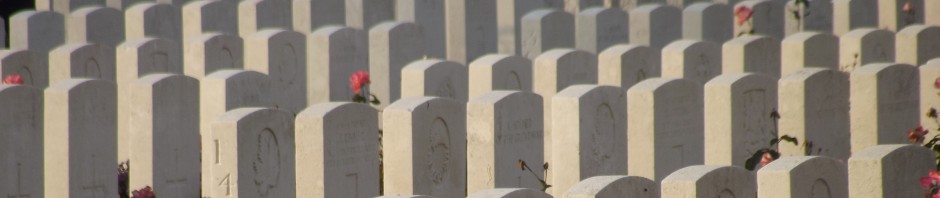
Cross of Sacrifice at Canada Farm Cemetery, Ypres

Cross of Sacrifice at Canada Farm Cemetery, Ypres

So here we are in 2014, a year that will see the start of over four years of events to commemorate the centenary of the First World War. One hundred years since a conflict that affected most households in the country, a conflict that had far-reaching repercussions on the world that we live in today, a conflict that holds an enduring fascination for many people.

I regularly tweet about First World War related news stories, and the amount of coverage that has already been given to the war over the last year or so has surprised me.  There have been articles about different aspects of the conflict, soldiers’ stories, and centenary plans on an almost daily basis. Many stories have covered the proposals being developed by communities up and down the country, and indeed across the world, to commemorate the war.

This sense of anticipation has also been added to by several well-known authors, academics, and historians, as well as TV personalities, releasing books about the war during 2013. Titles by Max Hastings, Jeremy Paxman, Gary Sheffield, Kate Adie, Saul David, Margaret MacMillan, Christopher Clark, Peter Doyle, and David Reynolds have all the hit the shelves prior to the centenary; with numerous publications due to be released over the next four years it seems some publishers are getting in there early. I just hope that this pre-centenary rush does not contribute to war ‘fatigue’ before the centenary has even started.

Organisations such as the Western Front Association and Commonwealth War Graves Commission will play a key role over the next four years. I have been fortunate enough to have had a sneak preview of a couple of projects in the pipeline from The National Archives and the British Library, and needless to say digital content and online accessibility feature heavily. The BBC has also released details of its centenary programming. It remains to be seen whether television and the media use the centenary period to properly re-examine the conflict or to just rehash many of the myths and perceptions that still seem to be held.
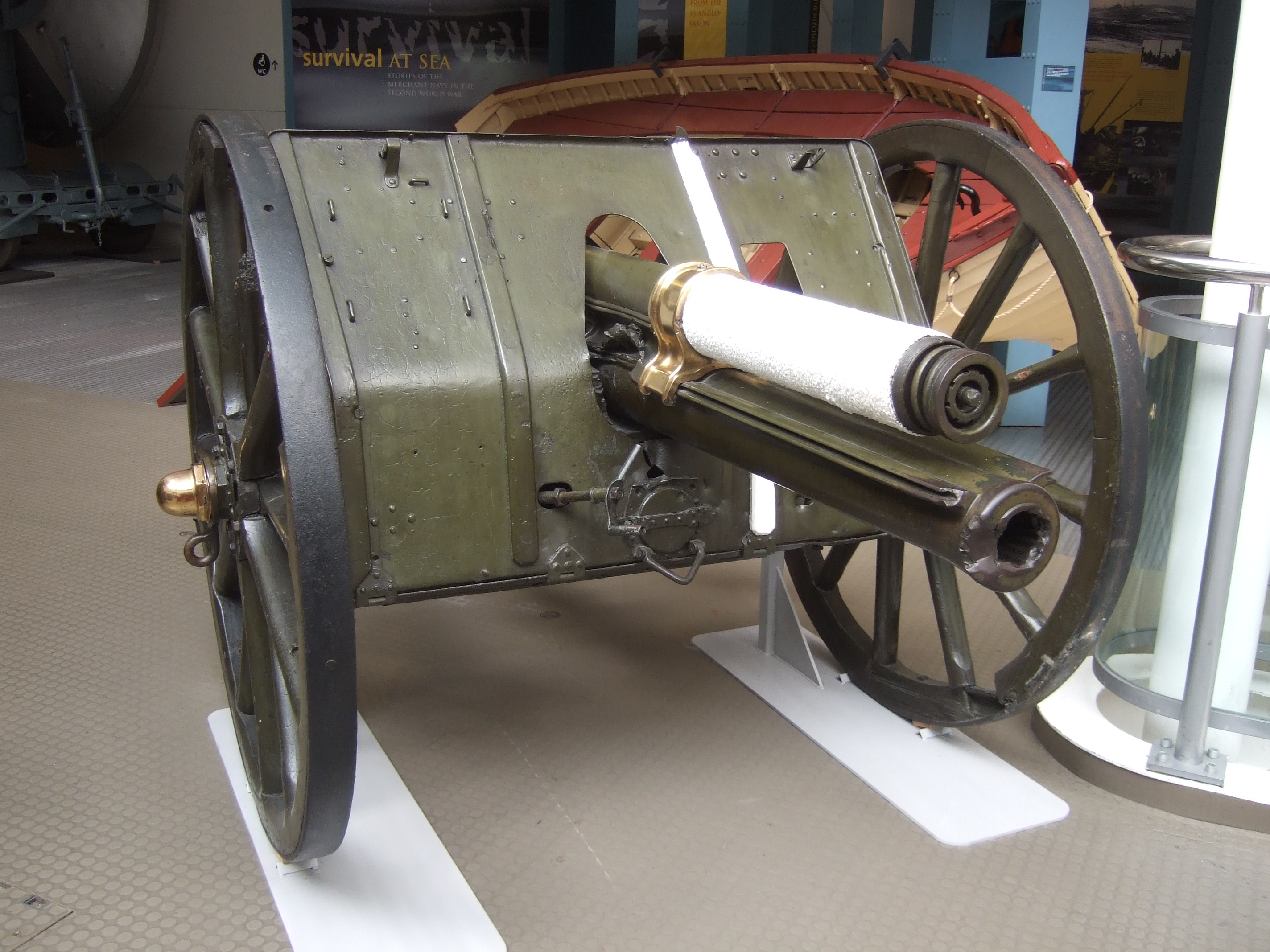
18 pound field gun at the Imperial War Museum

18 pound field gun at the Imperial War Museum

However the most anticipated plans are surely those of the Imperial War Museum. With the help of government funding, the IWM are completely remodelling their First World War galleries as well as redeveloping much of the museum itself. I have been visiting the museum since I was a boy and was a big fan of the First World War dioramas, trench experience, and atrium with the Old Bill bus and Mark V Tank. The museum was established as a direct consequence of the war, so it seems fitting that the galleries are updated now to take into account revised perspectives of the war. Technology is also sure to feature heavily; as museums such as In Flanders Fields in Ypres have shown, it can be integrated into exhibits to help understand the course and conduct of the war and the experiences of those who fought in it.

The Imperial War Museum are also working on Lives of the First World War, an ambitious project to create a permanent national digital memorial to those that served in the war. As well as a fitting tribute to those who served, this has the potential to be a valuable resource for historians and genealogists. During my own research I have come into contact with many families of men on my local war memorial who have been only too happy to share their ancestors’ stories, letters, and pictures. Lives of the First World War gives people the platform to share these stories on a national level. If only such a database had existed five years ago when I started my research!
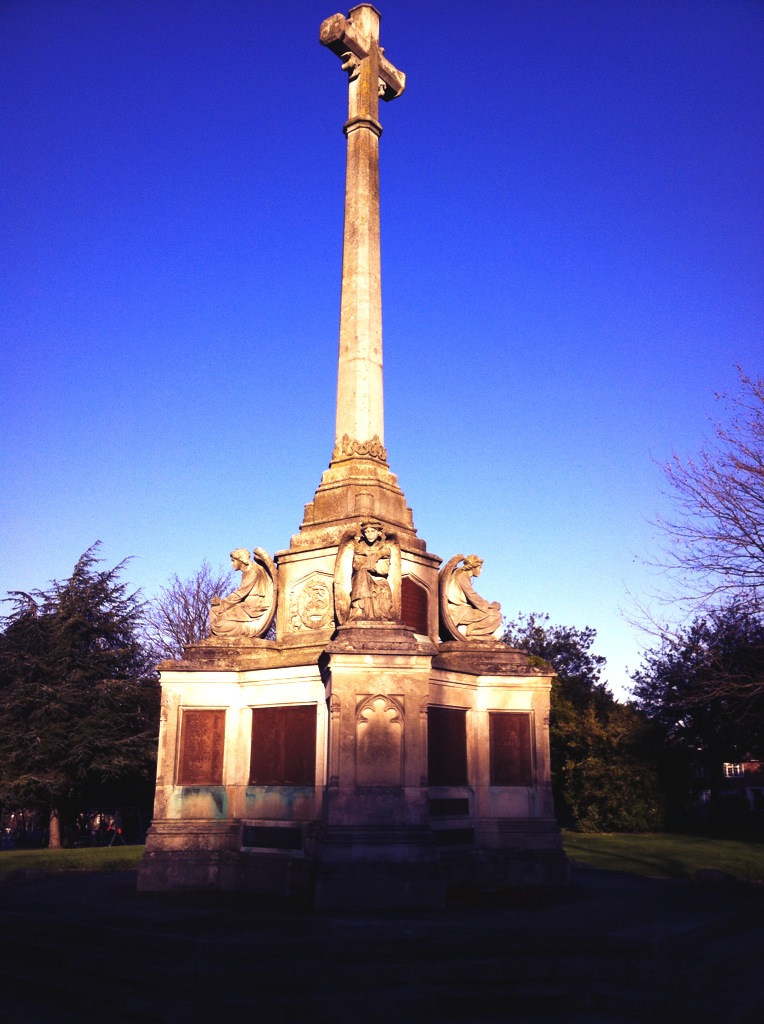
Sutton war memorial

Sutton war memorial

For me the most important aspect of the centenary is the remembrance of the soldiers at a local level, to ensure the stories of those whose names are inscribed on memorials up and down the country are told, and their contribution remembered. There are a plethora of projects in the pipeline to support this, supported in many cases by Heritage Lottery Fund grants, but in others being carried out by individuals and groups who just have an interest in the war and commemorating the men and women who served. I think projects such as Lives of the First World War will go a long way to ensure that this happens. The project is due to go live on 20th February 2014. You can also follow them on Twitter.

My own plans focus initially on the publication of my own book about the men commemorated on Carshalton war memorial, due to be published by The History Press later this year. This blog reached the milestone of 5,000 hits in December, and I hope to develop it further as the centenary progresses with more book and media reviews, and posts telling the stories of some of those who served. I am also looking to run some trips to the Ypres salient and Somme battlefields, focusing on the stories of the local men from Carshalton, Sutton, and Wallington who fought in the war. So watch this space for further details later this year, and thanks to everyone who has supported my blog and encouraged me during 2013.

Posted in Centenary, WW1 | Tagged , , | 1 Comment

Christmas Day casualties

Earlier this year I accompanied a school group on their trip to Ypres, led by Steve Garnett of Gesta. The first stop on the salient was Essex Farm Cemetery, where John McCrae wrote his famous poem ‘In Flanders Fields’. After an introductory talk by Steve, the students were given some time to look around the cemetery.

For most of them this was the first Commonwealth War Graves Commission cemetery they had visited and they were obviously moved by what they saw. There are over 1,200 soldiers commemorated in Essex Farm, including Valentine Strudwick who was killed aged just 15, only just older than some of the students themselves. Looking at the differences between the headstones they asked a number of pertinent questions – what the different insignia meant, why some of the rows were neat and others weren’t, why some had no name – and so on.

One of the students came up to me and asked why a group of soldiers were all buried close together; on closer examination they were nine men all from the 17th King’s Royal Rifle Corps, their date of death 25th December 1916. I have visited Essex Farm on a number of occasions but had not picked up on this group previously. The men are buried in plots II.W.1 – II.W.9, a row that stands alone at the back of the cemetery to the right of the Stone of Remembrance. I surmised that it was likely they were all killed together in the same incident. I recently came across my picture of the headstones from that trip, and resolved to check what had happened that day.

The graves in Essex Farm cemetery

The 17th Battalion KRRC, was one of the new army service battalions. They had been formed in May 1915 by the British Empire League, a pro-imperialist organisation, and had landed in France on 8th March 1916.

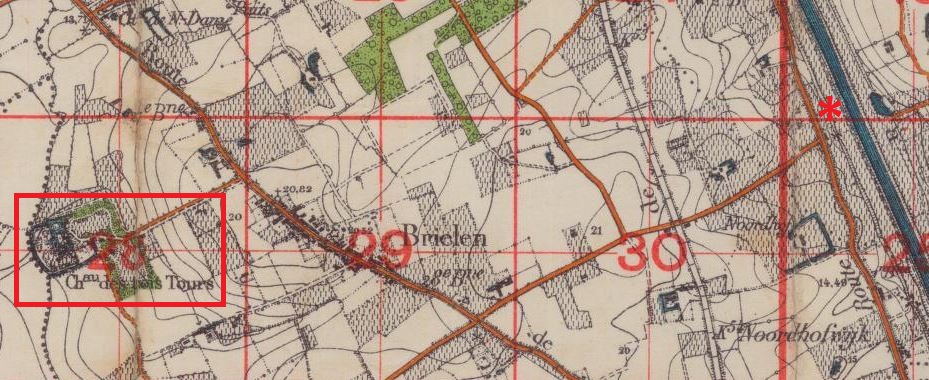
The battalion had spent December training and in reserve interspersed with spells in the front line near the Yser canal. Casualties from shell and rifle fire had already been incurred on the 19th. The four days prior to Christmas were spent in reserve, but on Christmas Day, they headed to the frontline near Brielen, north west of Ypres. Their headquarters was situated at Trois Tours chateau.

The area the 17th KRRC were in on Christmas Day. Trois Tours chateau marked with red box, Essex Farm with red star

The area the 17th KRRC were in on Christmas Day. Trois Tours chateau marked with red box, Essex Farm Advanced Dressing Station with red star

The battalion war diary records ‘Normal routine is carried out, the xmas holiday being postponed until Brigade moves into reserve. The battalion moves up to the front line holding its former position. At 9pm our artillery bombarded the enemy’s trenches. During the hostile retaliation we incurred casualties amounting to nine other ranks killed and five wounded.’

After the unofficial Christmas truce of 1914, efforts were made to ensure that this did not happen again in 1915; Christmas Day 1916 was no different and the CWGC database records that 267 men died on 25th December 1916.

The nine men from the 17th KRRC who were killed that day and are buried at Essex Farm were:

Corporal Arthur William Lake, aged 25. Son of Emily Jane Lake, Of “Roxburgh,” Russell St, Sidmouth, Devon. He is commemorated on Sidmouth war memorial. The epitaph on his headstone at Essex Farm reads “Waiting the Lord’s coming in the clouds for me from heaven”.

Rifleman William George Lampon, aged 19. Born and lived in Peckham.

Rifleman Herbert James Matthews, aged 19. Born in Charlton. Son of Elizabeth and James Matthews, of 28, Adelaide Rd, Brockley. His epitaph reads “There is no death tis but renewing life”.

Rifleman Frederick Henry Scoffield, aged 24. Son of Henry T. G. and Rebecca Scoffield, of 6 Bulwer Rd, Ipswich. His epitaph simply reads “Rest in peace”.

Rifleman Clyde Barton Slator, aged 37. Son of William Barton Slator and Emma Slator, of Greenwich; husband of Ada Louise Slator, of 11, Maidenstone Hill, Greenwich. He had enlisted on 17th June 1916. He is remembered on his parents’ grave in Greenwich cemetery along with his younger brother Gordon, killed in 1918.

Rifleman Charles John Smith. Born in Portsmouth and lived in Stoke Newington.

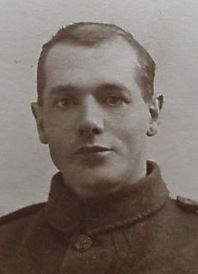
Still, FrankRifleman Frank Albert Still, aged 35. A Grocer’s assistant from Stoke Newington

(Picture courtesy of Barbara Still, Frank’s granddaughter)

Rifleman John T Tilley. Born in St. Pancras and lived in Camden.

Rifleman George William Wearn. Born in Lea Green, Hants.

Christmas was just another day in the trenches for these men, their deaths statistics of the daily attrition of trench warfare. However the fact that they all died together on Christmas Day and are all buried together adds an element of poignancy, which resonated particularly with some of the students on that trip.

Posted in 1916, Battlefield tours, Research, WW1, Ypres | Tagged , , , , | 2 Comments

A Great War Sniper

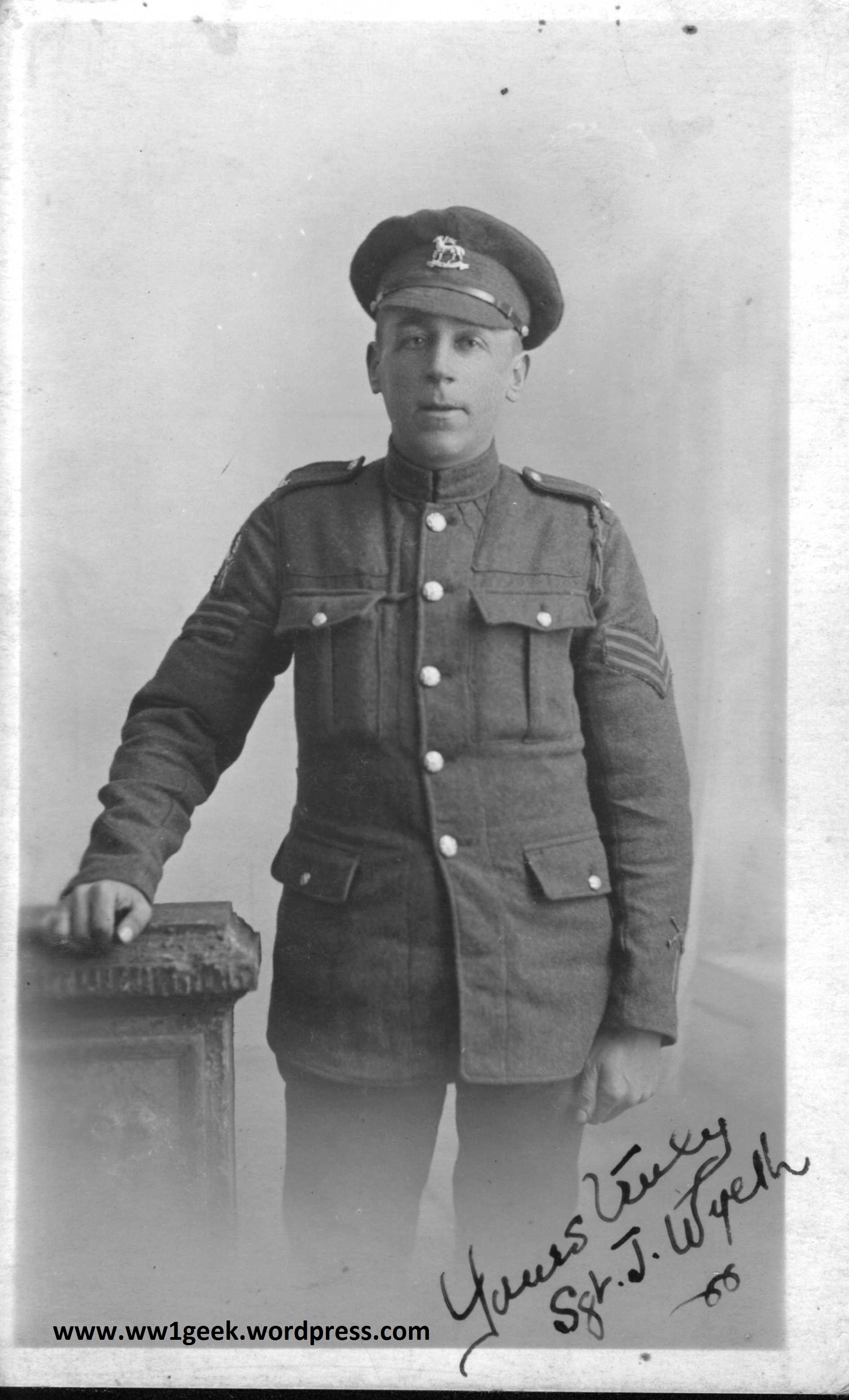
Wyeth

This photograph from my collection shows a Sergeant from The Queen’s (Royal West Surrey Regiment). Helpfully it is signed by the soldier ‘Yours truly Sgt. J. Wyeth’. However on searching the First World War service records and medal index cards (MIC), I could not find a soldier who matched those details.

However, there is a medal index card for a Charles J. Wyeth. Although there is no corresponding service record or pension record to confirm details, there are a few clues that make me think that these are the same person. Firstly Charles J. Wyeth’s MIC shows that he served in The Queen’s, firstly as a Private then as a Corporal. However, although the regiment matches, the man in the photo wears Sergeant’s stripes.

Charles J. Wyeth also has a second MIC, for the award of a Meritorious Service Medal (MSM), which provides some further information. The MSM was a gallantry award for non-commissioned officers, and Charles Wyeth’s was gazetted on 17th June 1918. Unfortunately there are no details as to why he was awarded it, but his rank on this MIC is given as Lance-Sergeant – effectively a Corporal acting as a Sergeant – which could explain why this is not reflected on his main medal card.

Notification of Charles Wyeth’s MSM in the London Gazette states that he was from Reading. A trawl of the census records shows a Charles Wyeth living in Reading in 1911, aged 23, working as a grocer’s porter. His father’s name was also Charles; if this is the correct Charles Wyeth this may explain the use of his middle initial rather than his first.

The MSM MIC also confirms that he served with the 6th Battalion of The Queen’s, attached to the 37th Infantry Brigade Sniping Company. His service number – G/32 – indicates an early volunteer into the 6th Battalion, one of Kitchener’s ‘New Army’ battalions.

The photo provides further evidence that they are one and the same man. On the soldier’s lower left sleeve can be seen the crossed rifles of the marksman’s badge, and a similar badge at the top of his right arm indicates that he was qualified as an instructor.

Initially snipers were unofficial and operated on an ad hoc basis in response to superior German snipers. As casualties from German snipers grew, a more co-ordinated approach was adopted and sniper training schools established, the first by Second Army near Ypres in December 1915. By the end of the war these schools trained intelligence officers as well as snipers, and a great deal of effort was put in to producing camouflage for snipers. Although it is not clear how they operated within the 37th Brigade, snipers were certainly active in the 6th Queen’s; their war diary entry for 7th January 1916 for example states “Very quiet day…our snipers claim three hits.”

One final clue helps to date the photo. On the soldier’s lower left arm below his marksman badge is a wound stripe; this indicates that the photograph was taken some time after July 1916 as wound stripes were only introduced then, although they were applied retrospectively to wounds incurred since the start of the war.

The evidence seems to point to the man in the photograph being Charles J Wyeth, G/32, 6th Battalion The Queen’s. Part of the 37th Brigade, 12th (Eastern) Division, the battalion served overseas from 1st June 1915 and their battle honours include Loos, the Somme, Arras, Cambrai, and Amiens. Whilst he did not escape injury, Charles survived the war, and died in 1959, aged 70.

Sources
London Gazette
Medal Index Cards
1911 census
Death registers
6th Battalion The Queen’s war diary

Further reading
Pegler, M – Sniping in the Great War
Pritchard, H – Sniping in France (free download)

Posted in Research, Surrey Regiments, WW1 | Tagged , , | 1 Comment

‘This officer served his machine gun…until he had been shot five times’ – Jack Dimmer VC

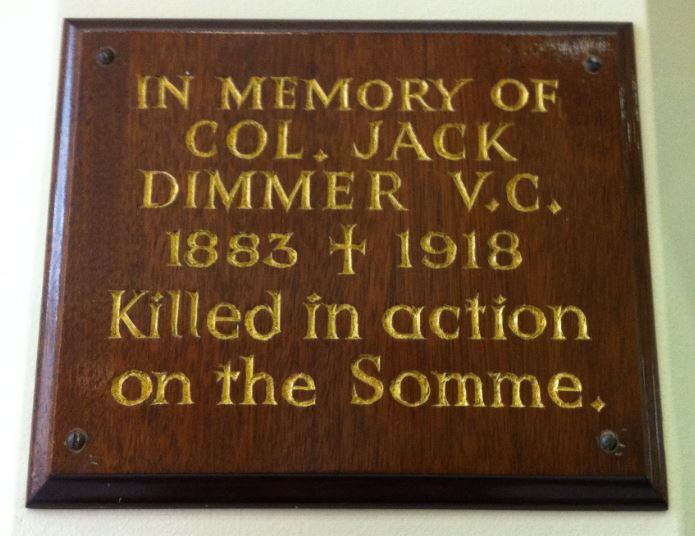
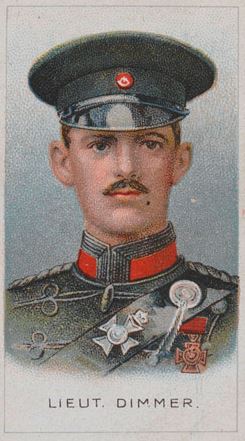
PlaqueA few years ago I worked for the London Borough of Merton. Based at the Civic Centre in Morden, for nearly two years every day I walked past a small plaque in the foyer to Lieutenant Colonel John Dimmer, VC. I was recently reminded of this when I picked up a set of VC winner cigarette cards, Dimmer among them, and resolved to find out more about him.

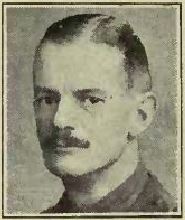
John Henry Stephen Dimmer (known as Jack) was born in 1883 in Lambeth. He attended Merton Church School before being awarded a scholarship at Rutlish School. After a spell as a civil engineer he became a career soldier, joining the King’s Royal Rifle Corps in 1902 and seeing service in Africa. He rose through the ranks and when the First World War broke out went over with the BEF as a Lieutenant with the 2nd KRRC.

Lieut DimmerJack was not one to shy away from danger. Arthur Conan Doyle, in his work ‘The British Campaign in France & Flanders’ (volume 1) recounts one incident from 17th September: ‘On the extreme right of the British line a company of the 1st Northamptons occupied a most exposed position on the edge of the Chemin-des-Dames. The men in a German trench which was some hundreds of yards in front hoisted a white flag and then advanced upon the British lines. It is well to be charitable in all these white flag incidents, since it is always possible on either side that unauthorised men may hoist it and the officer in command very properly refuse to recognise it; but in this case the deception appears to have been a deliberate one. These are the facts. On seeing the flag, Captain Savage, of B Company Northamptons, got out of the trench and with Lieutenant Dimmer, of the Rifles, advanced to the Germans. He threw down his sword and revolver to show that he was unarmed. He found a difficulty in getting a direct answer from the Germans, so he saluted their officer, who returned his salute, and turned back to walk to his own trench. Dimmer, looking back, saw the Germans level their rifles, so he threw himself down, crying out, “for God’s sake get down.” Captain Savage stood erect and was riddled with bullets.’

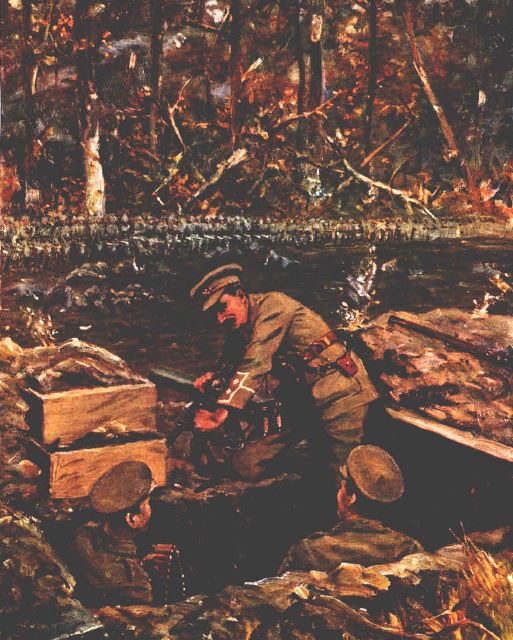
During the First Battle of Ypres, on 9th November the 2nd KRRC had been moved up to support the London Scottish near Klein Zillebeke, south east of Ypres. Occupying trenches at the edge of a wood just 120 yards from the Germans, they were subject to artillery bombardment and German attacks, which were all repelled. The attacks continued throughout 10th and 11th November. Jack Dimmer had at least two narrow escapes, on each occasion a bullet passing through his cap – probably from German snipers who were active in the area. On 12th November the Germans launched another massed assault. Jack Dimmer was awarded the VC for his actions during this attack. His citation reads:

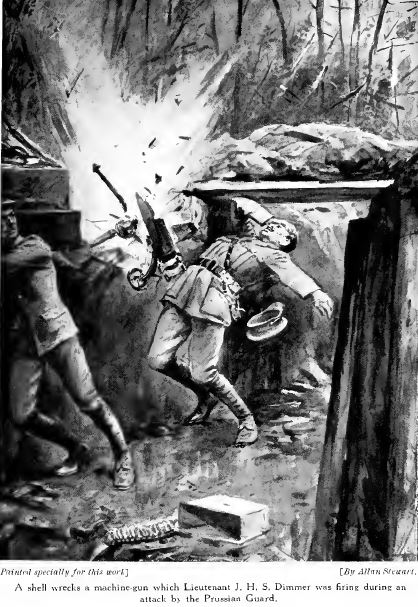
‘This officer served his machine gun during the attack on the 12th November at Klein Zillebeke until he had been shot five times – three times by shrapnel and twice by bullets, and continued at his post until his gun was destroyed.’

Dimmer - VC action

Dimmer recounted the action himself in a letter to his mother: ‘Here is how it all happened. On Thursday last, at about one o’clock, we were suddenly attacked by the Prussian Guards – they shelled us unmercifully and poured in a perfect hail of bullets at a range of about 100 yards. I got my guns going, but they smashed one up almost immediately and then turned all their attention on the gun I was with, and succeeded smashing that too, but before they completed the job I had been twice wounded, and was finally knocked out with the gun. My face is spattered with pieces of my gun and pieces of shell, and I have a bullet in my face and four small holes in my right shoulder. It made rather a nasty mess of me at first, but now that I am washed and my wounds dressed I look quite alright.’

Even his own account belies the danger he had put himself in. This account from ‘Deeds that Thrill the Empire’ gives an idea of the intensity of fire that he faced:

Dimmer VC‘At 1 p.m., the Prussian Guard, in mass formation, advanced from the wood, the men marching shoulder to shoulder in perfect order, as though they were on parade. At once the British machine-guns began to spit death amongst them, Lieut Dimmer firing one of the guns himself, and the storm of bullets tore through their serried ranks, mowing them down as corn falls before the sickle. But still they came on, and presently the Lieutenant’s gun jammed, owing to the belt getting wet. In a moment he had climbed onto the emplacement, a large adjustable spanner in his hand, and got the deadly weapon again in working order; but as he did so, a rifle bullet struck him in the right jaw. Heedless of the pain, he began to pour a fresh stream of lead into the advancing masses, but he had not fired many rounds when the gun stuck when traversing. Reaching up to remedy the stoppage, he was again hit by a rifle bullet, this time in the right shoulder. But he got his gun going again for all that, and before the blast of death the Huns fell in swathes. Then a shrapnel shell burst above him and he was hit for the third time, three bullets lodging in his injured shoulder. But, with the blood streaming from his wounds, the heroic officer went on firing his gun, until, when within fifty yards of our trenches, the Germans suddenly broke and ran for cover. Their artillery covered their retreat with a rain of shrapnel, and Lieut Dimmer’s gun was hit and destroyed, and his face splattered with splinters of broken metal. Exhausted with pain and loss of blood, he lost consciousness for a time, but on coming to, insisted on proceeding to Brigade Headquarters, to report in person to the Earl of Cavan, commanding the 4th (Guards) Brigade. Scarcely, however, had he made his report when his strength gave out, and he collapsed and was taken to the dressing station.’

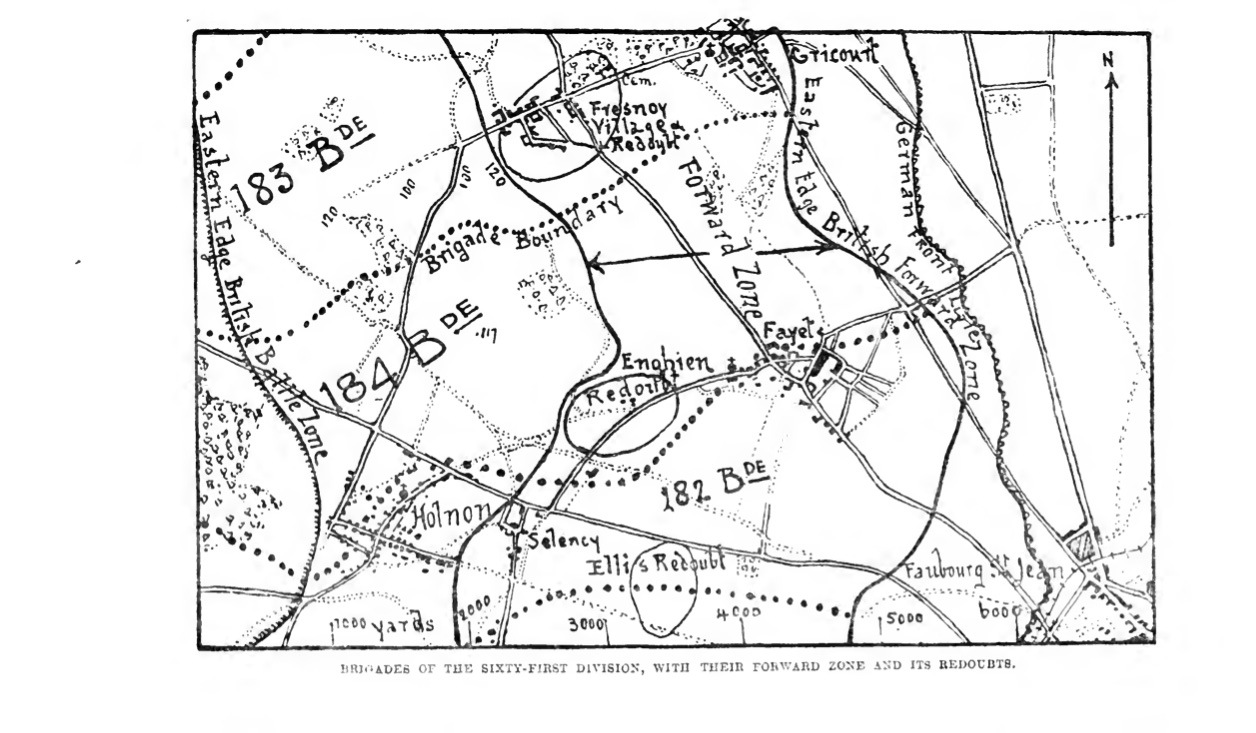
After recovering from his wounds he spent time on the staff and also attached to the Royal Flying Corps in Salonika. In October 1917 he was attached to the Royal Berkshire Regiment, commanding the 2/4th Battalion. On the first day of the German’s spring offensive (21st March 1918), the battalion were based at Ugny-l’Équipée, west of Saint-Quentin:

‘Order to man battle stations was received at 5am. Battalion moved off at 6.30 arriving at MARTEVILLE at 8.30am, thence to RAILWAY CUTTING between VERMAND and ATTILLY. At 3pm B and C Companies counter-attacked enemy in front of ELLIS REDOUBT. D Company were in Support with Battn HQ at ELLIS REDOUBT, and A Coy were withdrawn to RAILWAY C UTTING. The enemy was encountered in overwhelming numbers, and the parties were compelled to withdraw under very heavy MG fire to RAILWAY CUTTING. Lt Col J H S DIMMER VC, MC was killed…and heavy casualties sustained by the rank and file.’

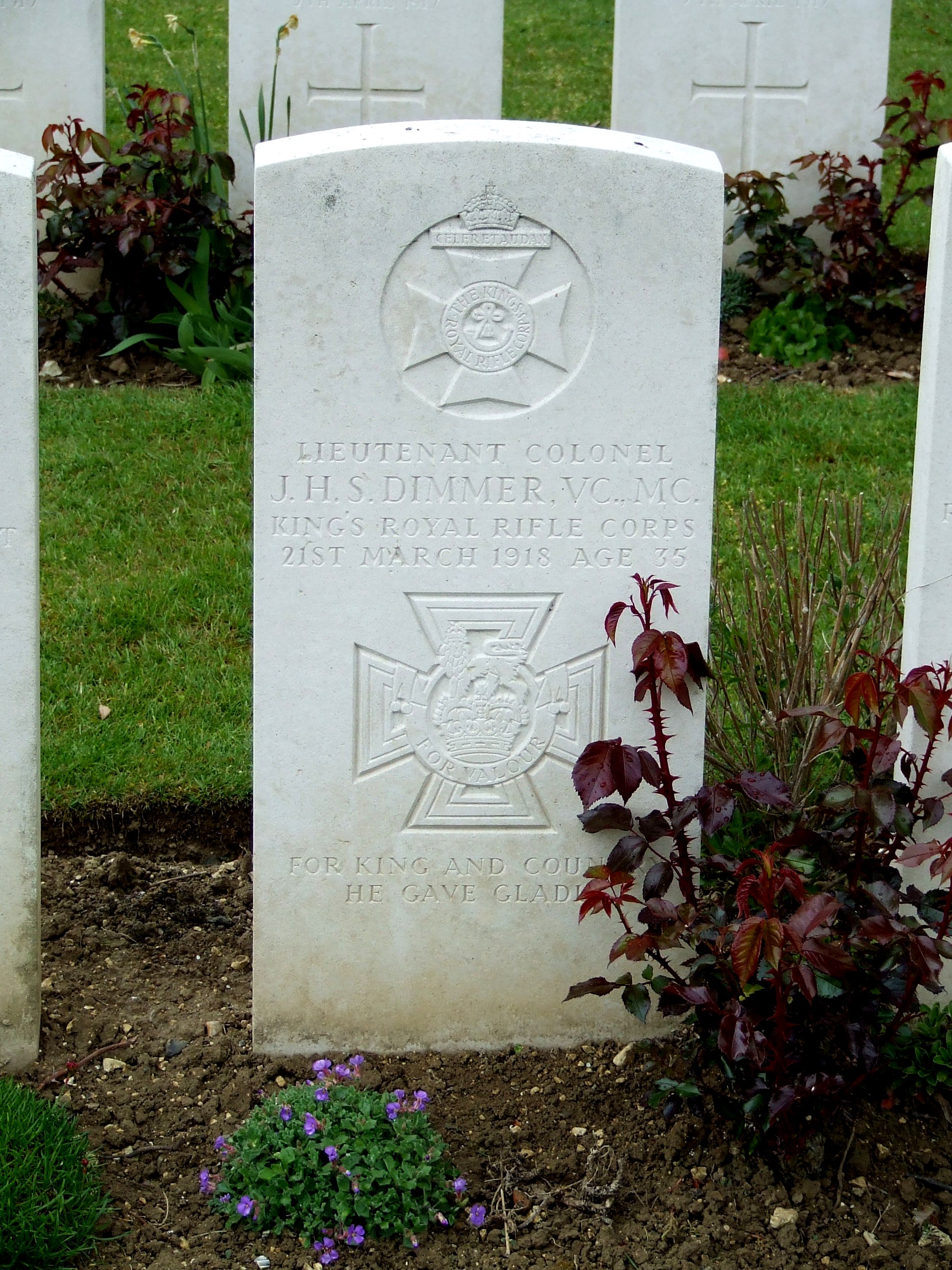
Dimmer had been leading his men on horseback, and was shot through the head close to the German lines. He is buried in Vadencourt Military Cemetery, Maissemy (north west of St. Quentin), close to where he fell. His epitaph reads ‘For King and country he gave gladly.’Ellis redoubt

In addition to the plaque at Merton Civic Centre, he is also commemorated on Wimbledon war memorial, and has a road named after him (Jack Dimmer Close in SW16). His VC is displayed at the Royal Green Jackets Museum in Winchester.

Jack Dimmer VC

Courtesy of British War Graves - www.britishwargraves.co.uk

Courtesy of British War Graves – http://www.britishwargraves.co.uk

Sources
Commonwealth War Graves Commission
Deeds that Thrill the Empire, vol.1
The British Campaign in France & Flanders, vol.1 & vol.5
The Fifth Army in March 1918
The Times
The War Illustrated, vol.10

Posted in First Ypres, Gallantry, WW1 | Tagged , , , , , , , , , | 7 Comments

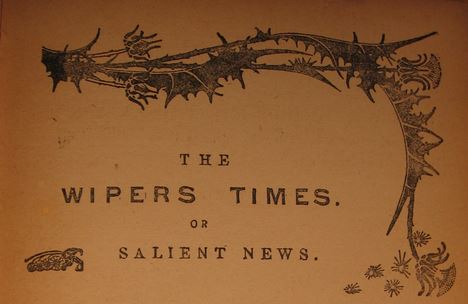
The Wipers Times

A new comedy drama starring Michael Palin is set to tell the true story of how troops during the Great War found a bout of humour on the battlefield using an abandoned printing press. Nina Koo-Seen-Lin takes a look at the publication that has inspired the programme.

The Wipers TimesDuring the Great War, a soldier’s life was a trench life. During lulls in the fighting – when no sudden attacks, gas or artillery barrages loomed – soldiers would often divulge in various activities to pass the time. Much information on the troops’ pastimes in the trench can be gathered by stories from family members and ancestry websites and paraphernalia shown in war museums, such as footballs, playing cards and old war time journals.

Many men took to physical labour to relieve themselves of boredom, setting out to dig trenches whilst others took to playing cards. Some men wrote poems and songs to sing while marched to and from the trenches. Their words reflected the hardships the soldiers endured in the trenches and the misery of being cold, exposed to diseases and frightened.

Yet not all soldiers picked up a pen to note the terrors of war. Some men believed that comedy should be employed in a cathartic role against tension, fear and grief caused by fighting. And so, The Wipers Times was born.

Founded in 1916 in YpresThe Wipers Times was set up after troops from the Sherwood Foresters salvaged an abandoned printing press from the ruins of the Ypres battlefield and used it to produce the paper. They name of the paper derived from the army slang for Ypres.

The paper was edited by Lieutenant-Colonel F.J Roberts, who later received the Military Cross. Submissions were encouraged and the paper was additionally circulated around most of the Western Front. Contributors often used pseudonyms to sign their names rather than their own names – “one who would like to know” and “Granpa” – as it conveyed the idea of the type of caricature represented, and in this way new writers could take over should the original author be injured or posted elsewhere. Although all content was welcomed, the paper famously protested against the huge amount of poetry it was receiving:

We regret to announce that an insidious disease is affecting the Division, and the result is a hurricane of poetry…The editor would be obliged if a few of the poets would break into prose as a paper cannot live by “poems” alone.

Articles that filled the columns in The Wipers Times combined black humour and satirical swipes at allies and enemies alike:

OUR SHORT STORY
There once was a teetotal Q.M.
THE END

A succession of ‘in’ jokes and army jargon was used a lot which soldiers across the Western Front related to and drew them together as a unit sharing the same experiences.

The paper’s popularity provided it with a longevity compared to other trench newspapers. It ran from February 1916 until just after the war ended which is incredible considering the production of the newspaper depended on the editors being in reserve with an area where they could set up the printing press. Two editions were printed after the war under the name of The Better Times.

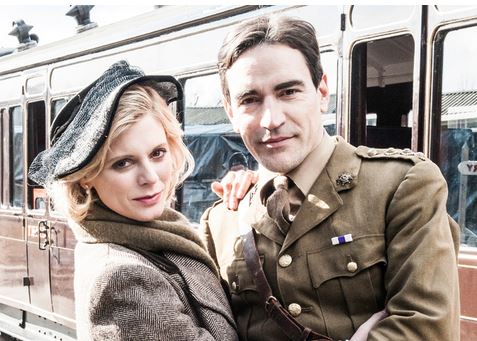
Ben Chaplin stars as Lieutenant Colonel Roberts

Ben Chaplin stars as Lieutenant Colonel Roberts

The story of how British soldiers in the trenches of the First Word War produced and published their own satirical newspaper will be televised in a BBC2 drama starring Monty Python’s Michael Palin. Private Eye editor, Ian Hislop co-wrote the script with cartoonist Nick Newman and the programme aims to be as full of jokes and spoofs with amazing examples of the courage behind the laughs.

The Wipers Times is scheduled to air on BBC2 later in 2013 – look out for a review here.

You can follow Nina on Twitter here

Posted in Centenary, Television, WW1 | Tagged , , , , | Leave a comment

‘The Glorious First of July’

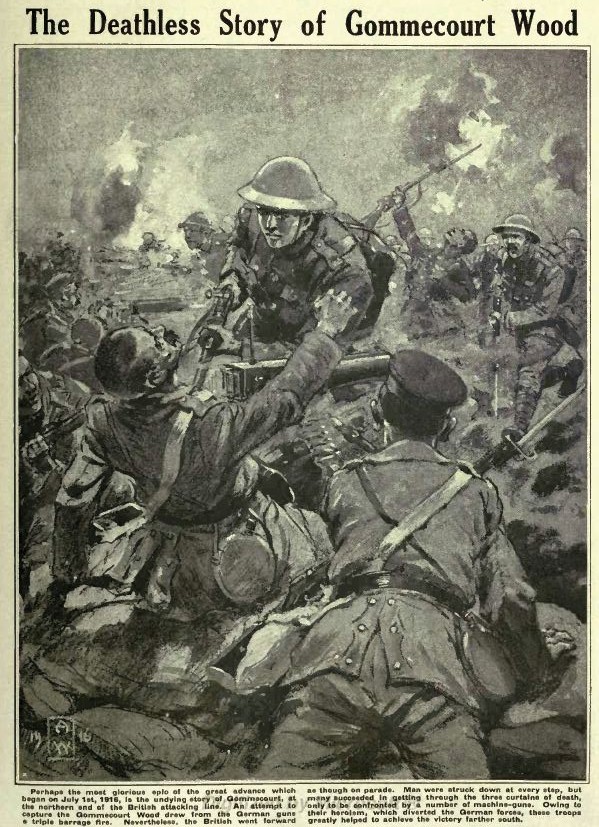
97 years ago today the Somme campaign began after a week long artillery bombardment. Initial reports of British and Commonwealth troops’ progress were promising and were reported positively in the British press, the full extent of the nearly 60,000 casualties yet to be known. The Times headlines on 3rd July stated ‘Forward in the West’ and ‘Start of a Great Attack’. It reported that ‘Sir Douglas Haig telegraphed last night that the general situation was favourable.’ The Daily Mail headlines included ‘Three Miles into the German Lines’ and ‘Enemy Outgunned’.

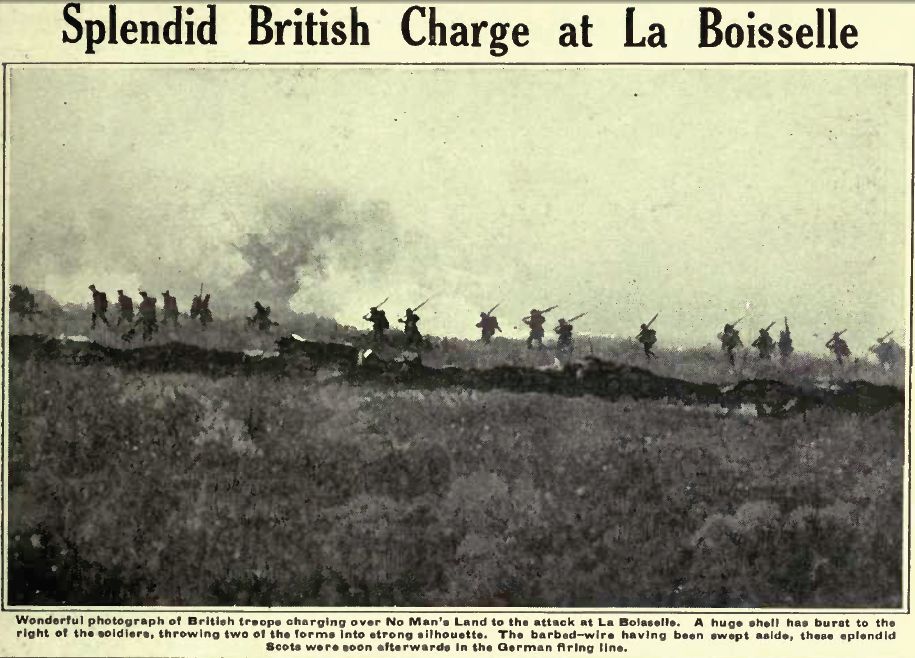
Splendid British Charge at La BoisselleThe War Illustrated, a weekly publication featuring rousing and patriotic articles and pictures, went even further. In an article titled ‘The Glorious First of July’ its correspondent Edward Wright wrote an account of the first day that belies the sheer amount of casualties and lack of progress on most of the British front. One wonders how many of the men who fought that day would agree with the sentiment of its title.

Extracts from the article are reproduced below:

‘Around Gommecourt were three curtains of intense shrapnel fire between our men and their goal. For here it was that the Germans had concentrated their main mass of guns. Yet the British troops came out steadily under the awful rain of death, raised their own machine-guns on the parapet, and then, dropping in hundreds, but never wavering, made their way across a zone of five hundred yards to the enemy’s front line.

GommecourtSouth of Gommecourt, between the Hill of Serre, the valley of the Ancre, and the ridge of Thiepval, our troops were at first amazingly successful. In a series of charges, as heroic as that made by the Scottish Division at Lens, our men took the German trenches, and then bombed their way into Serre and Thiepval, reaching the third and last line of German works. Some battalions had no casualties whatever in the rush against the German first line, but we did not allow for the remarkable intrepidity of some of the German machine-gunners. These men were devilish in spirit when our wounded lay at their mercy and tried to creep to shelter. At Serre and Thiepval they let our charging lines pass them, and then came out of their dug-outs, swept our rear, and knocked down our parties who were bringing up bombs for the troops ahead in the German third line. One German gunner was found wounded in nine places and still fighting like a dervish of the Sudan. Little more than a score of these determined men, working behind our victorious line, succeeded in stopping ammunition reaching our troops at Serre and Thiepval.

For in our main assault our success was swift and complete. We aimed at the great German salient built on a ridge overlooking our position at Albert, and known as the Fricourt salient from a village lying at the point of it. The main strength of the position, however, resided in a great fortified chalk ridge, some five miles long, extending from the hamlet of Boisselle to the village and brickfield of Montauban. The hamlet of Mametz rose on the southern slope of the ridge.

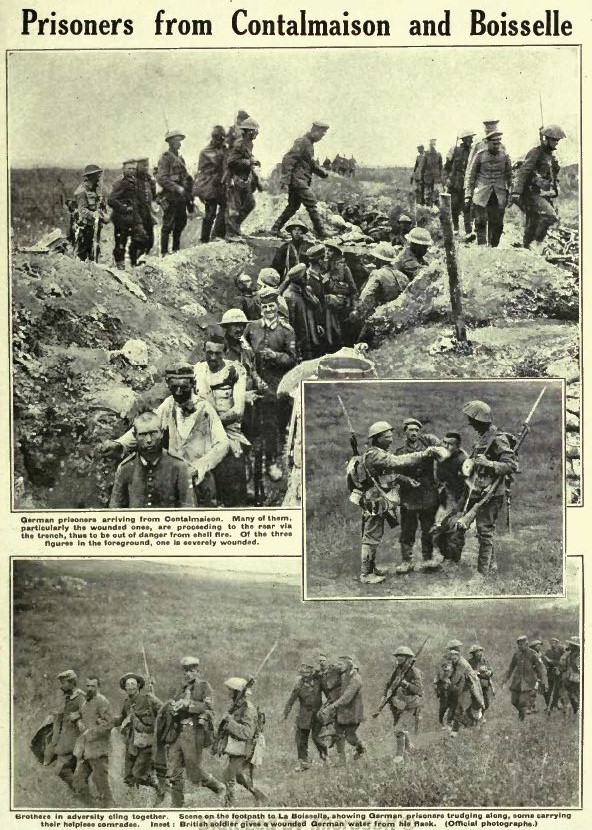
PrisonersWe did not make an immense, surging charge all round the great salient, but delivered two great thrusts. Fricourt was not attacked, but the line on either side of it was broken in two places about two and a half miles from each other. The Gordons advanced against Mametz, and, though raked horribly by machine-gun fire, stormed the position and held it. Then some miles away on their right the men of Lancashire, supported by the Surreys, Kents, Essex, Bedfords, and Norfolks, carried the main ridge at Montauban in one strong, narrow stream of invasion. At the other end of the ridge, by Boisselle, the Suffolks and the Tynesiders, with the Tyneside pipers playing on their men, swept by the northerly German hill fortress and advanced well beyond the salient to the village of Contalmaison. The Suffolks reached this village at the price of only one man killed, but again the German machine-gunners in our rear near Boisselle checked our advance for the time being.

The fact was our wonderful troops did more than had been expected of them. Fricourt was left untouched for two days, as we had made larger gains on either side of it than had been designed. Our principal attention was directed towards smashing up the reinforcements that Einem hurried towards the high ground on the ridge.

There we broke brigade after brigade, leaving Fricourt open like a trap for more Germans to enter. But we joined our two wedges round Fricourt on Sunday afternoon, stormed Boisselle the next day, and then resuming our onward progress advanced some miles eastward along the road to Combles.

So tremendous was the pressure with which we pushed back Einem’s northern wing that General Foch’s army, in four days of sledge-hammer work, took the plateau south of the Somme, dominated Peronne, hauled up the great French siege-guns, and brought Einem’s northern railway and motor communications beneath a heavy incessant shell fire. In other words, Haig’s and Foch’s armies did as much in four days’ fighting to threaten the German routes of supply at Peronne as the Germans had done in five months’ fighting to threaten the French routes of supply at Verdun.’

Posted in Somme, WW1 | 3 Comments

From Yeoman to Tunneller

My final post on the MacDuff family’s war experiences focuses on Donald MacDuff. Son of Peter and younger brother of William, Donald had a very interesting army career. On the face of it his war record seems quite strange; he started as a Private in the Scottish Horse and ended the war as a Second Lieutenant in the 184th Tunnelling Company of the Royal Engineers. His service record was to hold the key to this puzzle.

Donald as a Private in the Scottish Horse

Donald enlisted in Dunkeld on 3rd September 1914, aged 22. He stated that he had previous territorial service with the 7th Royal Highlanders (Black Watch) which he had joined in 1909; the same battalion as his father. He was posted to the 1/1st Scottish Horse and in March 1915 was promoted to Acting Lance Corporal.

The 1/1st Scottish Horse were sent to Gallipoli, where they served as infantry. They landed at Sulva Bay on 2nd September 1915 and almost straightaway started suffering casualties from shellfire. By the time they were evacuated on 28th December 1915 the three battalions of the regiment had suffered over 120 casualties, with no doubt many more wounded and sick. Donald, however, was not with them, having been invalided home with jaundice two weeks previously.

After recuperation, he rejoined his regiment; however it seems that around this time he decided to apply for a commission in the Royal Engineers. A letter to the War Office in his service record dated 8th August 1916 gives the reasons behind this:

Sir,

I have the honour to inform you that in accordance with your instructions I have today interviewed Private Donald MacDuff, no. 4170, aged 24.5, single, 1/1 Scottish Horse, Pitlochry, Perthshire, whose application was submitted by his C.O., to the War Office.

Pte. MacDuff was born at Lochgelly, Fifeshire, and received his education there until the age of 14 years, when he went for a period of 12 months to Dunfermline Technical College. He commenced his training with the Lochgelly Iron & Coal Coy., and after serving 4 years apprenticeship, received an appointment with the Dalmellington Iron & Coal Coy., Ayrshire, as Mine Surveyor. After being in this employ for 2 years, he returned to the Lochgelly Iron & Coal Company, and for one year acted as Mine Surveyor and Assistant Engineer. He then received an appointment with the Horden Coal Company Ltd., Durham, as Mine Surveyor and after 10 months service in this capacity, joined the Scottish Horse on the 3rd September 1914. After training, he was sent to Gallipoli at the end of August 1915, and was invalided home on the 14th December 1915 with jaundice, arriving in England on the 10th February 1916, re-joining his Regt., on the 1st April 1916.

Pte. MacDuff’s experience has been gained chiefly in the coal mines of Scotland, and he holds the Home Office Surveyor’s certificate. He is a qualified Surveyor, and tells me that he is experienced in shaft sinking, timbering through loose ground, the use of H.E. and low explosives with battery firing, mine pumps and fans, and compressed air drilling machines, and has also had some experience of the Proto set at the Cowdenbeath Mines Rescue Station.

Although Private MacDuff is underage, I am sending him up for your consideration and decision.

Captain G.M. Miles-Bailey, O.C. Depot, Tunnelling Companies, R.E.

I am unsure why he was referred to as ‘underage’ as I can find no reference to the minimum age for Royal Engineers or Tunnelling Officers being any different to that of the infantry.

Donald was commissioned into the Royal Engineers on 1st October 1916 and was sent for a week’s course of instruction with the South Staffordshire & East Worcestershire Mines Rescue Association in Dudley, before heading to the Royal Engineers in Chatham. On 10th November 1916 he joined 184th Tunnelling Company.

Donald MacDuff - Royal Engineers

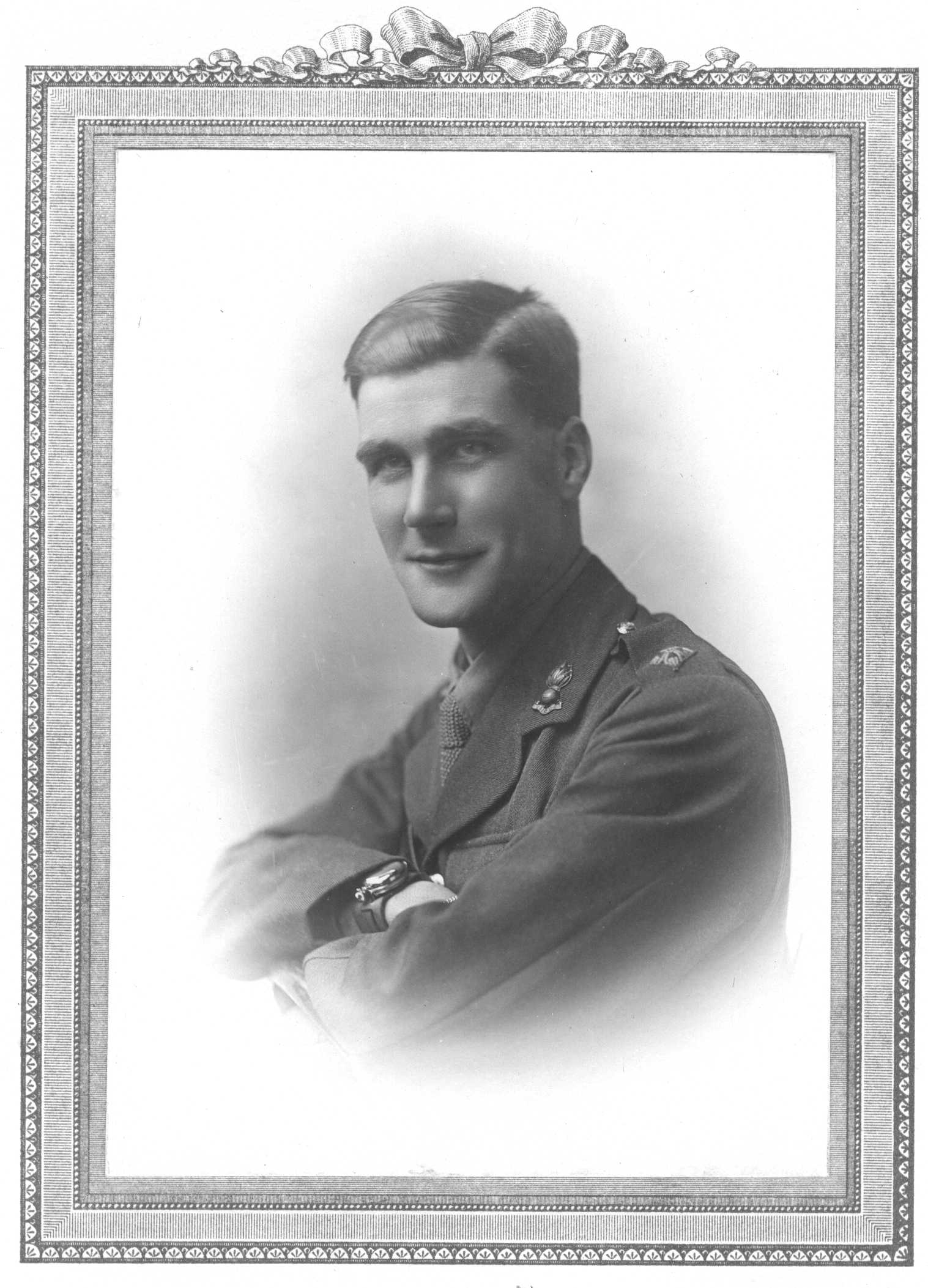
Donald after he was commissioned into the Royal Engineers

In April 1917 the Company were sent to Arras to work on ‘Fish Avenue’ tunnel and construct emplacements for mortars. In June they moved to Nieuport to construct underground shelters. Prior to the start of the Third Ypres campaign at the end of July the company were engaged preparing tank crossings. This highlights the range of work the tunnelling companies were engaged in, not always underground.

Donald remained with the tunnellers until 1918; returning from a course of infantry instruction near Messines on 28th March 1918 his hand was severely burned by mustard oil gas when handling camouflage netting on a dugout that had been saturated by the gas. He was sent to the 87th Field Ambulance on 17th April 1918 and from there to the General Hospital at Wimereux on 22nd April. Finally on 2nd May he was sent back to England, ending up at the Prince of Wales’ hospital for officers in Marylebone. The wound was classed as very severe and it was noted that it healed slowly.

However by August it had healed sufficiently and Donald became an instructor at the School of Military Engineering in Chatham. Here he was to stay until after the end of the war when he was demobilised in February 1919.

Details of Donald’s post-war life are sparse; he married and had a son and apparently went on to manage a tin mine in Nigeria. Family stories suggest his lungs were affected by the mustard gas later in his life. He died in 1965.

For more information about tunnelling during the war, see the excellent La Boiselle Study Group website.

For details of the Royal Engineers Tunnelling Companies see the Long Long Trail website.

Posted in Research, WW1 | Tagged , , , , , | 3 Comments

‘The Colonel’ – My Great Great Grandfather in the Black Watch

In previous posts I have written about my search for details of my Great Great uncle, William Brown MacDuff, who was killed in Belgium in December 1917. However as I started looking into my family tree in more detail, it soon became apparent that several other members of my family had also taken part in the war.

William MacDuff’s desire to serve with the Royal Highlanders (better known as the Black Watch) could be explained by the fact that his father, Peter MacDuff, also served with them.

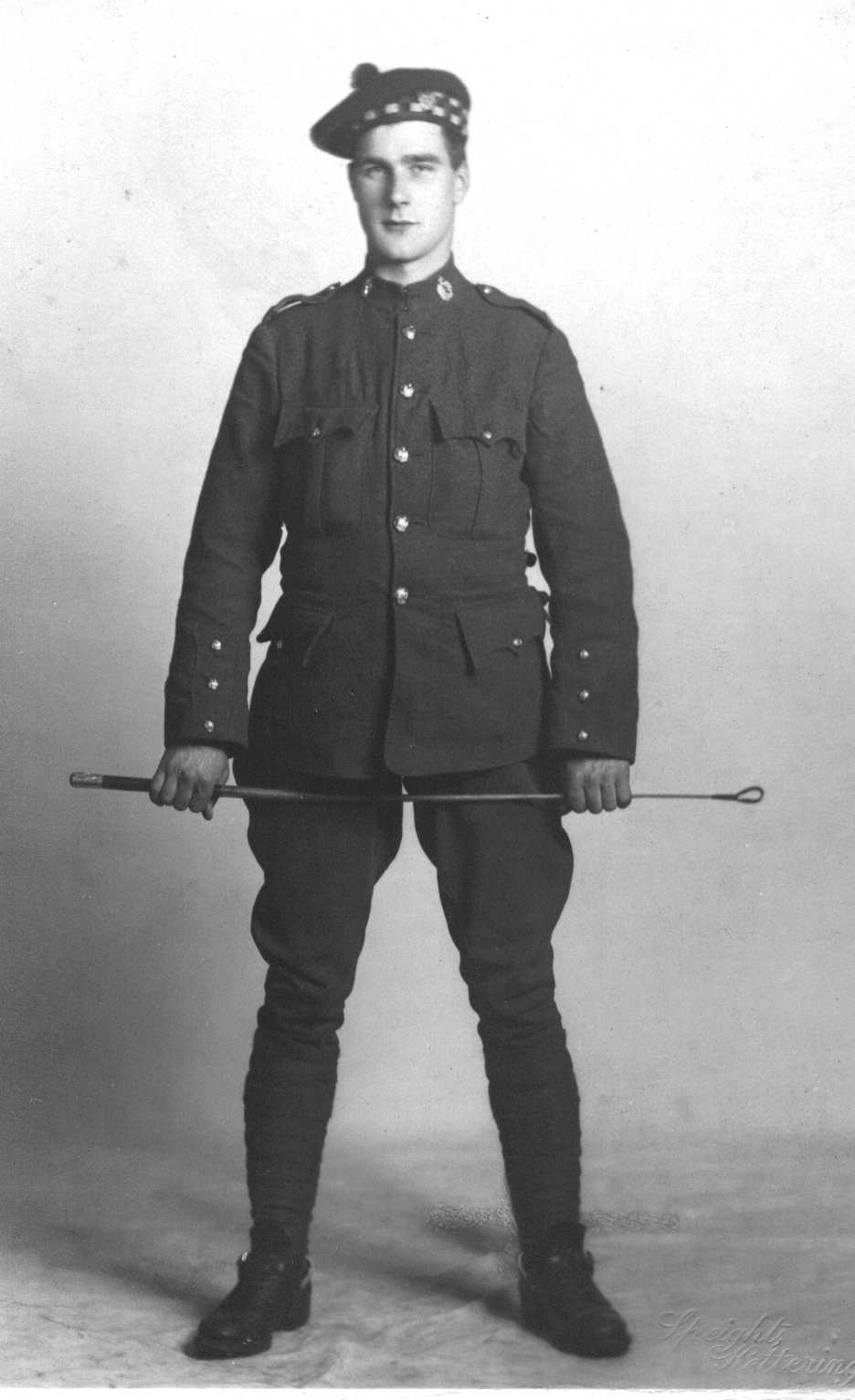
As I embarked on my search to find out more about him, existing details were hazy; it transpired that he was referred to as ‘the Colonel’ in the family (slightly erroneously it turns out; an affectionate nickname rather than an accurate one perhaps), and had been a school master. Not much else was known. However on acquiring a family photo album I was amazed to find a fantastic picture of him in uniform; immaculately turned out, he looks every inch the officer. I tracked down his medal index card, which confirmed that he had been a Major then a Lieutenant Colonel in the Royal Highlanders and ‘Staff’.

Since then I have been able to piece together further information about him. Although I cannot locate his service record, a search of local newspapers and the London Gazette yielded some interesting results.

After moving to Lochgelly in Fife to take up the position of Headmaster at a local school in 1889, he was commissioned as a Second Lieutenant in the 6th (Fifeshire) Volunteer Battalion, the Black Watch (Royal Highlanders). The battalion was also known as the ‘Lochgelly Company’. By 1903 he was a Captain, and by the time of the Territorial Act of 1907 he was in command of the company with the rank of Honorary Major.

In 1910 he was awarded the Territorial Decoration for 20 years Territorial service. I believe the photo of him in uniform dates from around this time, as a medal ribbon can be seen on his left chest and he is wearing the rank insignia of a Major. The ‘T’ Territorial insignia can also be seen on his collar.

Peter MacDuff

When war broke out Peter MacDuff was 56. Despite his age, in May 1915 he was sent to France with the 1/7th (Fife) Battalion, The Black Watch, part of 2nd Highland Brigade in the Highland Division. A few days after arriving, they became part of 153rd Brigade in the 51st (Highland) Division.

After initially being sent to the Ypres salient the battalion also spent time around Aveluy and Auchonvillers on the Somme, but on 9th November 1915 Peter was invalided home. From here I am unsure what his exact movements were. In January 1916 he was gazetted as a temporary Lieutenant Colonel. His obituary in the Dundee Courier states that he was then sent back to France in command of a pioneer battalion, before later being put in charge of the 3/7th Reserve Battalion of the Black Watch in Ripon, Yorkshire. The obituary goes on to say that when this battalion was merged with others in September 1916, he returned home. However, an article in another paper states that he was called up again in August 1917, finally returning home in February 1919. His retirement was announced in the London Gazette in March 1919.

In 1924 Lieutenant Colonel MacDuff led the ex-servicemen at the unveiling of the Lochgelly war memorial, on which his son William’s name in inscribed. His wife, William’s mother, laid the first wreath on the memorial. Some time ago I stumbled across original footage of the war memorial being unveiled. To my amazement Peter MacDuff can clearly be seen towards the right of the screen (e.g. between 2m 50s and 3m). One can only wonder what he must have been feeling as his son’s name was read out along with the other 268 casualties, many of whom would no doubt have been known to him as pupils at the local school during his time as Headmaster.

Peter MacDuff died in 1930, and his funeral was attended by many former members of the Fife Territorial battalion. He is buried in Ballingry cemetery, Fife.

Posted in WW1 | Tagged , , , , , , , | 4 Comments

A German Letter from the Front

ImageThere has been a great deal of interest on Twitter over the last few days in some amazing interviews with German veterans that have been translated by Rob Schaefer. This reminded that several years ago I acquired a First World War letter written by a German soldier to his family. As well as giving an indication of what conditions were like at the front it also highlights some of the hopes and fears of the soldiers in the trenches.

Thanks to a member of the Great War Forum, an approximate translation is provided below. The sender was Reinhard Gleitsmann of Reserve Ersatz Regiment Nr.2, 16th Armee-Korps, 27th Division.

Argonne, 24 November 1915

My dear Friedel, Heinz and Parents,

Sending you my very warmest regards. I am still well for the time being. It is very cold, even during the day. It is about 6-7 degrees, but that’s bearable enough. At least it’s more pleasant than the filth that sucks your boots off.

As I’ve already written, I have refused father’s kind offer with thanks. Each soldier has now received the following as gifts: 1 pair of wrist-warmers, 1 belly-binder, 1 pair of mittens, 1 woollen shirt and underpants, and also 1 pair of socks. You could say we won’t freeze to death at any rate, but you could send my fingered gloves, and I don’t know what else. A balaclava would be useful for when it’s very cold. You could make one, but make sure the wool is not too thick so that I can pack it in my backpack. My parcels without letter numbered 79, 80, 81 and 82 are on their way. Others to follow. I silently enclosed my fondest regards.

The day before yesterday we had the opening ceremony for our cemetery in the Argonne, in the midst of shell-blasted beech trees. Present at the service were General Schmidt, one platoon (strength approx. 50-60 men) from each company of our regiment, and two padres – protestant and catholic. A deeply moving service, in a place where any one of us might end up. To start with, the grave mounds of five men adorn the site. Together with ours, there are seven cemeteries in this sector, where so many a determined German head “has lost its crown”.

I must also report that I have received many kind parcels, from the Reusdorf parents (1 can of rabbit stew, and from you 1 parcel of Kermesse cakes which I happily consumed on 21st November in honour of our wedding anniversary. I hope you celebrated it appropriately too). I also silently remembered you, my parents, on your birthdays. May the Lord keep you well until we meet again. I have received a parcel of cigars from you.

In response to my request for little Heinz, please act as you see fit. One little toy horse and cart will bring him great pleasure. Do as you will, but ask my parents what would be best.

The fact that we will naturally have to celebrate Christmas in the Field again is too much for some of the men. Who could have expected it? The war has already cost so many brave German warriors, and will continue to do so.

With regard to galoshes for wearing inside the boots, the price is very expensive. Perhaps you can try, my dear Friedel. It is nice to have dry feet. Who knows if you can get these in Altenburg?

Farewell my dears at home

Fondest regards from your son and father

Give little Heinz a kiss from me

Reinhard

The German Volksbund database lists a Landsturmmann Reinhard Gleitsmann, who was killed on 8th August 1916 and is buried in Cheppy German cemetery, 20 miles north west of Verdun. Could this be the same man?

Posted in Uncategorized | Tagged , , , , | Leave a comment

February battlefield trip – part 2

On the second day of our trip we departed south from Ypres. Thick mist enveloped the countryside and visibility was minimal, and we wondered what it must have been like manning the trenches in similar conditions.

Our first stop was Ploegsteert memorial, designed by H Chalton Bradshaw and commemorating over 11,000 men.

Image

We then made a brief stop at Prowse Point cemetery, in an area closely linked to Bruce Bairnsfather, passing the Khaki Chums’ cross to the Christmas truce of 1914.

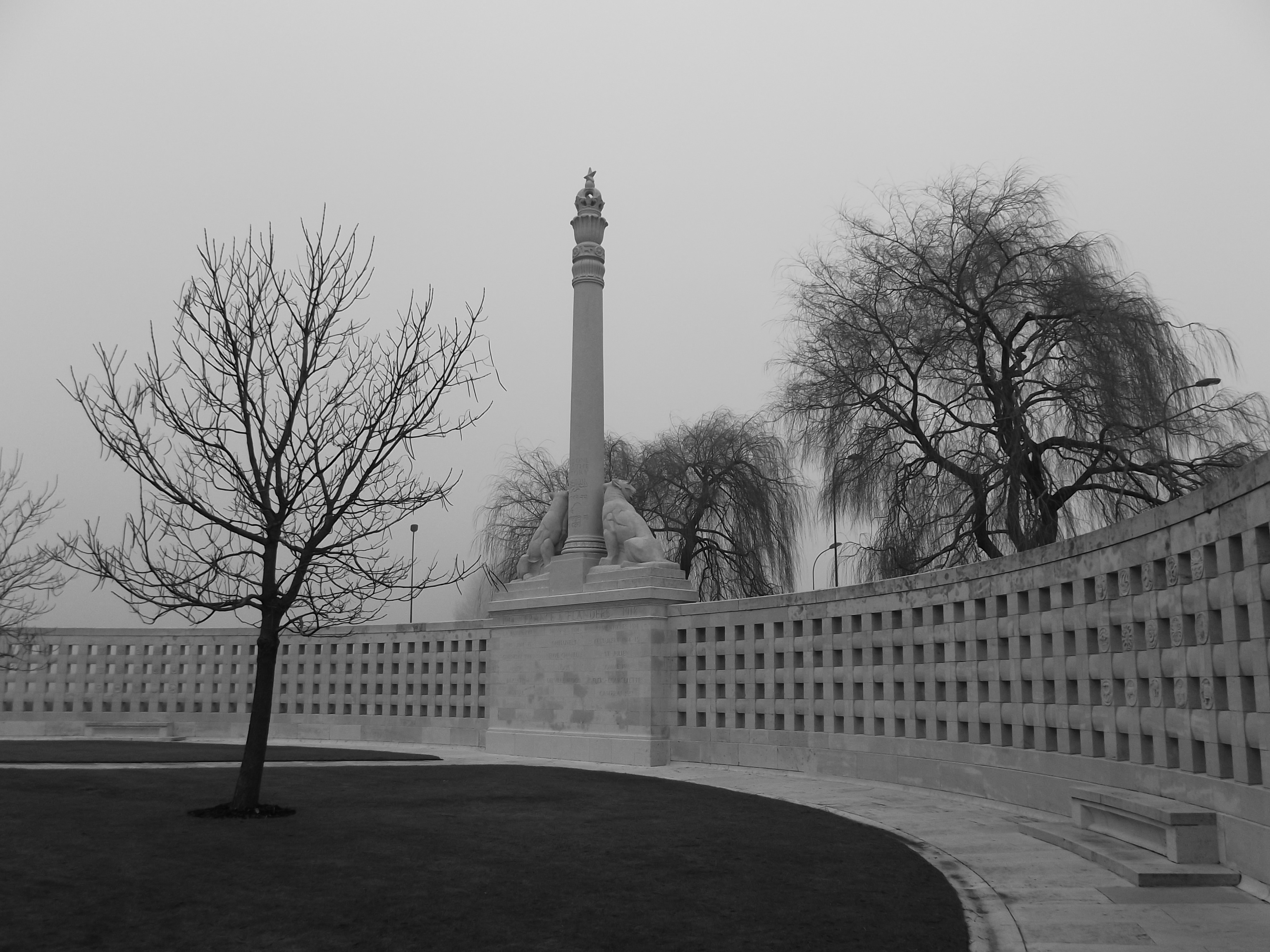
We continued further south through Fromelles, where work on the new visitor centre was well underway. Aubers ridge was shrouded in mist but numerous German blockhouses gave some idea of how they defended the area in 1915. The sun was just breaking through as we reached the Indian memorial near Neuve Chappelle; a lovely memorial dedicated to these men who died far from home, and which still bears the scars of the fighting of the Second World War.

Image

A short distance down the road is the Le Touret memorial, where five men from Carshalton are commemorated, and we stopped so I could find them and take some pictures. The design of the memorial is interesting and different to any of the others I have so far visited.

 Image

We then proceeded to the Loos memorial, which forms part of Dud Corner cemetery; ten men from Carshalton are commemorated here, mainly from the Loos campaign of September – October 1915. Five of these men, part of the 24th Division, had only arrived in France three weeks before the start of the campaign. Rushed to the front they were thrown straight in to the battle on the second day, many of them being killed in their first and only action.

Image

By this time the sun was out and visibility from the memorial was excellent. The landscape is fairly flat and featureless, still dominated by the double crassier and mining equipment, with the commanding heights of the Vimy ridge visible in the distance.

We also paid a visit to St. Mary’s ADS cemetery, where Rudyard Kipling’s son John has a headstone, although there are still some doubts as to whether it is his body actually buried there. Quarry cemetery is also nearby and the peace and tranquillity of this small cemetery belies the fierce fighting that took place at the nearby Hohenzollern redoubt. Image

We then left the ‘forgotten battlefield’ and made our way south to the Somme, mist once again enveloping the high ground and preventing us from seeing the Canadian memorial on Vimy ridge.

On arriving on the Somme our first stop was Thiepval memorial; a sight that does not diminish in effect no matter how many times you see it. 39 men from Carshalton are commemorated here, testament to the effect the Somme campaign had on one small village.

Image

Our next stop was Bapume Post military cemetery where another of Carshalton’s casualties is buried. Second Lieutenant Robert Madder was leaving a dugout close to the nearby Usna redoubt on 20th July 1916 when he was killed by a shell. The epitaph on his headstone reads simply ‘Duty and Sacrifice’.

Image

We spent the remainder of the afternoon driving round the area of the battlefield that formed the right flank of the British line. The 18th Division spent time here from the summer of 1915 and attacked there on 1st July 1916.

Our accommodation for the night was the Auchonvillers guesthouse, where our host Avril Williams provided a fantastic meal and we spent the evening engaging in interesting conversation to say the least with ex-British Army veterans over a glass or two of wine.

The following morning Avril showed us the cellar of her house which was used during the war as a dressing station amongst other things and connects to the communication trench in her back garden. She also has a museum over the road filled with a collection of artefacts from both world wars.

Image

We soon departed and headed back towards Thiepval. From here the 18th Division memorial looks out towards Thiepval wood and the Ulster tower, and gives some indication of the clear field of fire the Germans would have had as the 36th Division left the wood to attack the German lines. It was a bitterly cold day and reminded us of how the soldiers in the trenches must have felt without the benefit of modern fleeces and thermal wear.

ImageThe threat of heavy snowfall back in the UK meant we had to change our plans and head home earlier then planned, however we managed to visit a few more cemeteries on the southern end of the battlefield – Norfolk cemetery; Fricourt new military cemetery; Dantzig Alley; Caterpillar Valley; Longueval Road; and the AIF Burial Ground at Flers.

We also walked over some of the ground that the 18th Division attacked over on 1st July between Mametz and Montauban. The open expanse of farmland with its gentle rolling slopes offers no cover and it is hard to imagine what the conditions must have been like on that day.

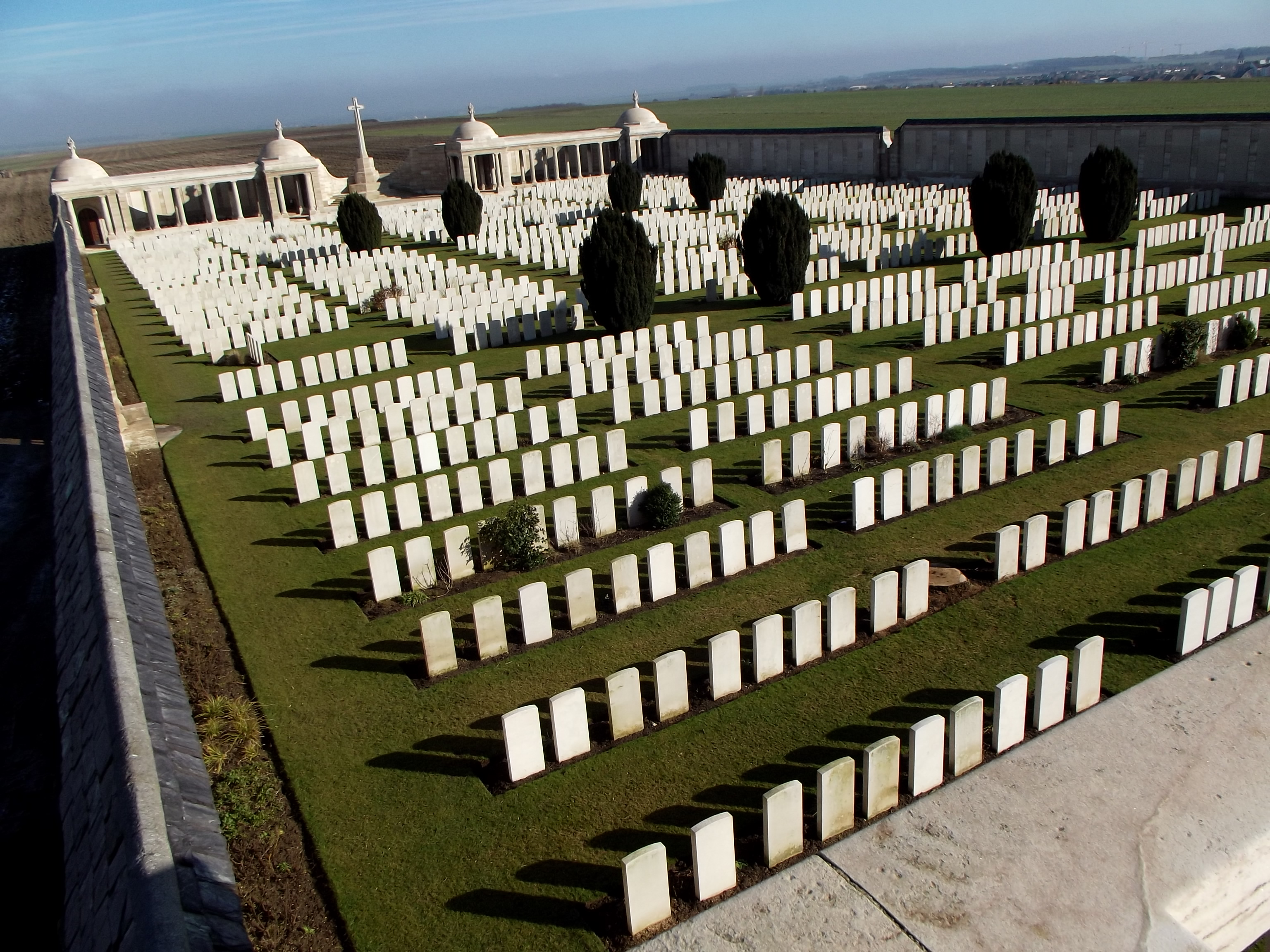
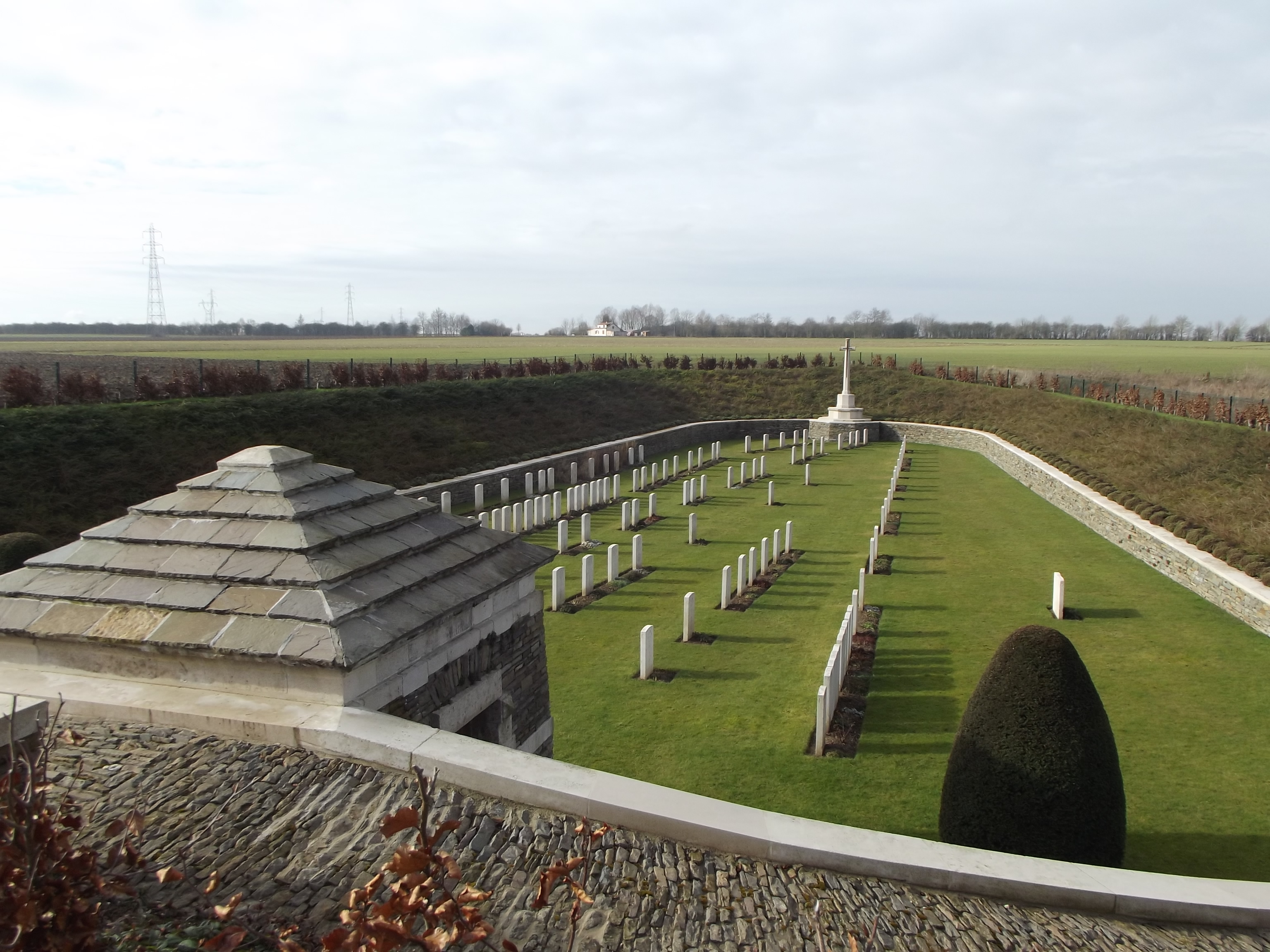
We headed back to Calais, passing many CWGC cemeteries along the way. It had been a brief but packed trip and one that has given me plenty of food for thought until I can visit again.


Posted in Uncategorized | Tagged , , , | 2 Comments